Monday, January 20, 2014

A Year In the Life of a Debut Author: Timeline Edition

Hi guys! Happy Monday!

Hard to believe it, but it's been a little over a year since I announced my first book deal. So what's happened since then?

Well, first off, there are quite a few great posts floating around the internet that talk about all of the steps involved in getting a book from a publisher’s initial offer to the actual bookshelf. One reason I think this post gets written a lot is because authors get asked about this a lot—except it’s usually phrased like “Your book sold when? And it’s coming out when? Why so far away?” And then I, at least, just sort of nod and smile and say, “yes, it’s normal for a big traditional publisher to take that long, no it doesn't mean they hate my book, yes, I am very patient, thanks, etc...”, and then I try to explain everything that’s been happening behind the scenes, but I usually mix up my dates and words and end up just losing people halfway though.

So! I thought I’d write something on the subject down in a post, so I can just direct people to it instead. And because I liked specific dates and stats and stuff when I was researching everything before I was published (and even after, too), I thought I’d be as specific as possible—although, of course, this shouldn’t be used as a guide, since publisher’s timelines—even among the same imprints and same editors at the same house—are going to vary wildly.

This is just for fun, just for those curious about what my past year has looked like. Also keep in mind that this is my only experience, and it’s with one of the Big 5, and I’m sure other publishers work different, and that’s cool. Yay for other publishers and all the methods we now have for sharing beautiful books with the world! This is not a “let’s compare one publisher to another and talk about how slow traditional publishers are and how they’re going the way of the dinosaurs and blah blah blah!” sort of post. Incidentally, I’d never write one of those posts, because I happen to think my publisher is pretty kickass, and honestly this past year hasn't felt that slow at all. But I digress.

Right, anyway, here are some of those promised “behind-the-scenes” stats for you; enjoy! :)

Initial Offer on FALLS THE SHADOW made: January 3, 2013

Offer Accepted: January 14, 2013

Offer Announced: January 15, 2013

Contract (after agent negotiations) signed:  March 18, 2013

First Edit Letter Arrived: May 3, 2013

First Round of Edits Deadline: June 3, 2013

Second Edit Letter Arrived: July 29, 2013

Second Round of Edits Deadline: August 26, 2013

Book is considered D&A’d:  August 29, 2013
(D&A stands for “delivered and accepted”, which basically means I held up my end of the contract and produced a publishable book, which means I then get the second part of my advance, and we move on to…)

Copyedits Arrived: October 14, 2013

Copyedits Due: October 28, 203

First Look at my Book’s Cover: November 14, 2013

First Pass Pages Arrived: December 23, 2013

First Pass Pages Due: January 13, 2014

Official Release Date for FALLS: September 16, 2014

So there you have it. These are all the bigger things that have gone on this past year; all of this, of course, in between writing a new book (and a half!), revising said new book, and doing things like setting up interviews,  cover reveals, working with my editor on flap copy, filling out author questionnaires, eating lots of cookies, etc…


If you have any questions, ask away in the comments and I’ll do my best to answer!


Stefanie Gaither writes YA novels about killer clones and spaceships, with the occasional romp with dragons and magic-users thrown in for good measure. Said writing is generally fueled by an obscene amount of coffee and chocolate, as well as the occasional tennis and/or soccer break. She's represented by Sara Megibow of Nelson Literary, and her debut novel, FALLS THE SHADOW, is forthcoming from Simon and Schuster Books For Young Readers in 2014. You can add it on Goodreads here!


You can find her on Twitter @: https://twitter.com/stefaniegaither
Or drop her an email at: stefanie.gaither@gmail.com
And also visit her website @: www.stefaniegaither.com 
Friday, January 17, 2014

Outlining for a Novel with Dual POVs

I'm baaaaack! 

Hey, everyone! I've rejoined the blogging world this month after my little maternity hiatus. And you know, I'm glad I took a break. Anyone who's had a baby knows that first month is a blur of feedings and poopy diapers and "Why is her head shaped like that? Is something wrong?" and drool (hers and mine). Blogging wasn't on my mind.

But now it is, and it has been since I started drafting again this month. See, I'm trying out this new thing: dual POVs. I've never done anything like this before, and honestly, I've never really wanted to. If there's one thing that bugs me about a dual POV book, it's when I have to keep flipping to the beginning of the chapter to decipher who is actually speaking. And you know, that happens a lot. So I decided that I wasn't going to attempt dual POV unless I was positive A) the story called for it and B) I could figure out a way to distinguish their voices enough.

(I'm still working on and failing at B, but that's another topic for another day.)

So since I haven't quite figured out B yet, let's talk A. How do you know your story absolutely needs a second POV to get the job done? The simplest answer is that one character has information that the other couldn't possibly know, and your readers need that information to make the story make sense. There you go. Think of Lena and Hana in Lauren Oliver's REQUIEM. They're at different, integral locations in the story, each fighting in the revolution in their own way from both inside and outside of the city. We need to know what's going on in both places in order to understand how the climax comes about, yes?

So I came to the conclusion that I needed both of my main characters, airplane mechanic, Nell, and her major screw-up BFF, Ronnie. Great. But how to outline?

I'm a Save the Cat beat sheet purist, and that method works well to outline when you're following one main character through a story. (I did a whole long post on how to outline with a beat sheet over on Pen and Muse if you want to check that out first for reference). So here's what I did to make this story structure make sense, and hopefully this can help you too!

When you're writing for dual POVs, I think it's important to remember that each of your main characters need to have their own, individually compelling plots and sub plots. If one is coming out as kind of the "sidekick," then you either don't need that character's POV, or you need to give him/her a bigger piece of the story. Example: When I first did the beat sheet for this story, it looked a lot like this:

  • Nell fixes the airplane engine, the fire alarms go off; Henry gets in the plane she fixed
  • Ronnie talks to her brother
  • Nell runs to the scene of the arson, finds a clue in the rubble
  • Ronnie talks to her uncle
See what I mean? I had to give Ronnie her own story. So this is what I did to make sure that happened: 
  • First, take a look at a beat sheet. Here's a quick reference guide.
  • For each section on the beat sheet, write two points: one for each character. Example: the first section is the Opening Image on the beat sheet, so if you're writing dual POV, you need to write a point for each character's opening image. On mine it's "Nell: working on an engine in her garage, pulls out her dad's old notebook. Ronnie: is sitting in the air traffic control tower with her uncle while he works because she's in trouble again, and he doesn't trust her to be home alone." 
  • Do this for every single section.
  • When you get to the start of Act III, your characters' stories should be converging. Right around the climax is when you want your reader to see why, exactly, you needed both of them in this story. Think of THE SCORPIO RACES. We had Sean and Puck's POVs the whole time, but it really made our hearts pound when we got to see their opposing thoughts during the race (Is Sean going to throw the race for Puck and lose everything? Is Puck going to let Sean win? etc.). 
  • From Act III until the end, both characters' POVs should help bring the story to a satisfying ending. They each should have their part in closing out the story. 
And that's that! Honestly, I'm still learning about this whole multiple POVs thing as I go along, but this method has worked pretty well so far. Have you written in multiple POVs before? Any tips or tricks to share? Add them in the comments! 

Andrea Hannah writes about delusional girls, disappearances, and darkness with a touch of magic. When she's not writing, Andrea runs, teaches, consumes epic amounts of caffeine, and tries to figure out how to prevent her pug from opening the refrigerator (unsuccessful to date). She's represented by Victoria Marini of Gelfman-Schneider/ICM, and her debut novel, OF SCARS AND STARDUST, is coming from Flux in Fall 2014. You can add it on Goodreads here!

You can find her on Twitter @: http://twitter.com/andeehannah
Drop her an email @: andreahannahbooks@gmail.com
And visit her website @: http://www.andreahannah.com/


Wednesday, January 15, 2014

Subjectivity Sucks: A Guest Post by Sarah Blair

Subjectivity sucks. It just does. It’s a fickle mistress. One that every writer must be, er… subjected to if they want to put their shiny darlings out on display for the world to read. Wouldn’t it be great if we could write a book with characters we love, an engaging plot, and words that speak directly to the core of every single reader’s soul? It’d be like the writer version of the One Ring. One book to rule them all, and I would keep it in my pocketses and call it my Precioussss.


Unfortunately, pleasing ALL THE READERS is a thing that doesn’t exist. People are unique. Readers have different interests and experiences that they bring to the pages. It affects their interpretation of what they read. No writer can control that. It’s out of our reach. 

However, sitting here and telling you that is a very different thing than believing it for myself. I can type the words until my fingers fall off, but that doesn’t mean it won’t sting when that rejection shows up in my inbox. We writers pour everything into our manuscripts. We put off time with our loved ones, let the dishes pile up, and the DVR fill to the brim with unwatched shows, all in the name of making our book the very best it can be. Obviously EVERYONE should enjoy it, right? Because if someone doesn’t, it’s like they’re saying, “Your best isn’t good enough for me.”

Except that’s NOT what they’re saying. It may very well feel like it, but it isn’t. Not even close.

I’ve seen both sides of Internet writing contests. I’ve been a contestant as well as a slush reader. As a contestant, when you don’t get chosen, it’s hard to deal with. It’s even worse when you read the tweets or comments and see that ugly word SUBJECTIVITY pop up over and over. It’s difficult to believe that the slush readers, or mentors, or agents, or editors you’re submitting to might like your words just fine, but they aren’t grabbed by them.


As a slush reader, you’re wading through these wonderful words and there are SO MANY GREAT ENTRIES it truly is torture to try to choose only one. To make matters worse, there may be an entry that grabs you by the collar and won’t let you go. It haunts your dreams and you’re still thinking about it when you get out of bed to brush your teeth. But, maybe it’s a genre that isn’t selling. Or maybe the agents didn’t have it on their wish lists. Should you go with your gut and choose that entry even though there’s a chance no one else will love that brain eating zombie princess the way you do? Or should you choose the other incredible gnome erotica because erotica is super hot* right now? It’s a really tough decision. And when it comes down to it, agents and editors have families to feed, just like writers do. Sometimes taking that chance might be slightly too risky for them.

Unfortunately, subjectivity is an ugly monster that you can’t conquer, no matter how hard you try. Having trouble with grammar? Go grab Strunk & White or get some quick and dirty tips from Grammar Girl. Can't seem to pin down showing vs telling? Get a handy dandy Critique Partner to call you out on it. Your ms is 10k too long for your genre? Grab a chainsaw and hack those words to bits. 


These are all things you have control over. Subjectivity? Not so much. It’s that elusive ethereal thing that no one can quite put their finger on. 

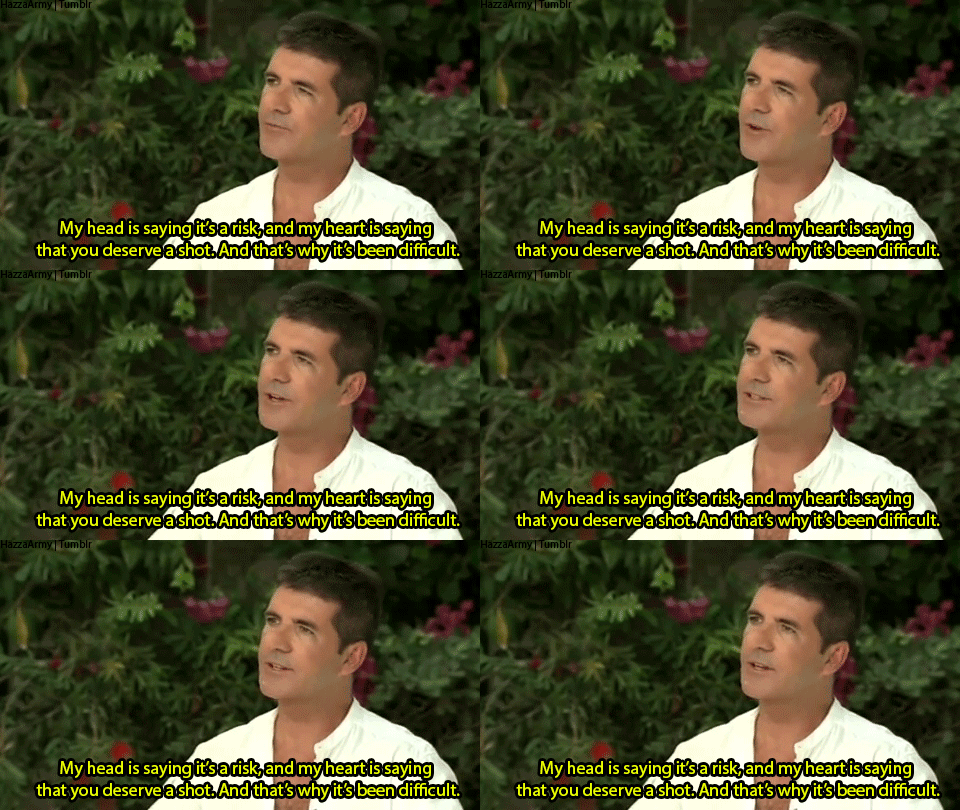
Simon Cowell probably can't define what it is that gives some singers the X-Factor--that special spark that takes them from being another member of a church choir, to overnight superstar. He simply knows it when he sees it, and even HE doesn't nail it every single time.


Agents and editors know how to spot that X-Factor in the slush pile. Simon Cowell is just one person. The best part about the literary world is that there are TONS of agents, LOADS of editors, and ALL the readers. 

So, yeah, subjectivity may be fickle, but the pool of potential readership is deep and wide. As long as you write a book YOU want to read, and more importantly, DON'T GIVE UP, you can find someone else out there who loves what you've created as much as you do.


*I read this five times before I caught my own pun. I is clearly kan write good. #TWSS


Want more from Sarah Blair? (I don't blame you) You can find her here!
Twitter: @SarahLBlair 

Monday, January 13, 2014

Take a Walk

Sometimes I think that while we're busy exhorting ourselves to work like crazy, there's this idea that taking breaks, or letting anyone know that you take breaks, is a sign of weakness. Like, if you were a "real writer" you'd just power through it, because writing is an act of will and this will-train stops for no one.

And hey, while I'd like to believe that I could keep going for a string of hours long enough to make up a day without breaks because I am just that willful, it's not true.

There's a difference between taking breaks because you can't get motivated and taking breaks because you've tapped all the juice in this well. If you've been there, then you probably know it. It's the difference between "ugh, that prose is gross and I don't want to deal with it yet" and "I am so exhausted coming up with fresh scenes and rewriting the past whatever many pages that I just cannot deal."

In the first case, yeah, that's about time for an act of will: time to put on the big author pants and suck it up. For the second one, though, when you're creatively fatigued, then maybe it's time to give in and do something different.

At one of my elementary schools, there were these kids who would come in after the school day had ended and we'd all gone home and, just like we had our assigned seats, so too were they assigned to desks in our classroom. You never got to see the kid who had your desk in person, but you'd see relics of their passing: an eraser that they left behind, a tennis ball missing from the feet of your chair.

And sometimes their actions would affect you. You could get a cool eraser or rescue a pen they forgot, or you wouldn't be able to erase their desk graffiti fast enough before a teacher checked on you.

It was cool when things were good, but also weird-- thinking that in some inverse world there's another person who sits at your desk at night, plays with the stuff you leave there, rearranges and changes some things, and leaves it there for you to find in the morning. Sometimes I feel like our relationship with the subconscious mind (if, oh God, this doesn't sound too psych class for a Monday morning) works the same way.

Your subconscious is part of the powerhouse generating your ideas. It's a cog in the creative machine, and just like you're taking care of other aspects of yourself, like going to the dentist, doctor, keeping healthy, sometimes you need to make sure the part of you that takes over when the lights go out is okay, too.

I love that we're dedicated and we're willing to work ourselves to death. That grit is what makes you succeed, for sure. But, on this hectic Monday and new week when no one really wants to go back to work, take a little time to recharge creatively.

Maybe it's scrolling through tumblr pictures of fantastic landscapes (or, tumblr pictures of Benedict Cumberbatch, because there's no judgement in the land of creative revitalization) or maybe it's reading a book, watching a few episodes of a TV series you love, knitting, or taking a walk. Do something else. Anything that gets you to stop thinking about whatever you're working on for a while, lets it sift over to the subconscious' side of the desk.

Sometimes when I'm crazy exhausted or have a big decision to make about how plot stuff goes, I go to sleep. And usually, after hours of not thinking about it, I'll figure out how to make things work when I'm in the shower or eating cereal, or trying to figure out how on earth eyeshadow works again. Sometimes it happens after ten hours of grad school, when my brain has been working on totally different stuff.

You've been told enough already that you have to be insanely dedicated to make writing work, and you know that it's still true. This takes a lot of effort. Just don't beat yourself up if you need a break sometimes, because, hey guess what, we all do.

When Alex Yuschik isn't writing her next YA novel, she's working on someone else's as an intern at Entangled Publishing. She writes about lock picks, ghosts, the abandoned places in cities, and how not to strike bargains with stars. Between sneaking in time to game and rocking out to indie music, Alex spends the rest of her free time working towards her PhD in mathematics. You know, as one does.

You can find her on Twitter @: https://twitter.com/alexyuschik
Or drop her an email at: alex.yuschik@gmail.com
And also visit her website @: alexyuschik.blogspot.com 

Friday, January 10, 2014

That Time I Conquered the First Round of Revisions

Helloooooo, Secret Lifers!! Gosh, it's been a while, hasn't it? So much has happened for all of us here at the Secret Life of Writers, and I know a lot has changed for some of you. This blog topic has come at the perfect time, because before last night, I really had no idea what I was going to talk about. But as it is, last night around 8:50 p.m. PST, I sent in my first round of revisions for my YA debut, THE GATEWAY THROUGH WHICH THEY CAME.

As most of you know, I announced my book deal with Curiosity Quills back in November, and since then my life has been a whirlwind of emotions. It's crazy how things can go from OMG I'M SO EXCITED MY BOOK IS GOING TO BE PUBLISHED to OMG MY BOOK SUCKS WHY DID I WRITE THIS SOMEBODY PUNCH ME. If you follow me on Twitter, then you saw this tweet from me posted last weekend:
Yep. That happened. I was stuck on a chapter for SIX HOURS. One stupid chapter. I just couldn't get my mind to process how to fix it. None of the sentences were making any sense and all the words were just jumbled together. My neighbors were stomping around above us, and the cars outside were so loud, and the TV screeched in my ears, and I completely broke down. I got up. Removed myself from the living room. Stood in my kitchen. And cried. 

I cried because everything was just so damn loud. I couldn't write. Couldn't concentrate. I was completely convinced that I couldn't do this. That I wouldn't get my revisions back in time. That my book was going to make absolutely no sense. And I was terrified that not a single person would even enjoy my book. 

In all honesty, that is the real reason I broke down. Because for the first time since I've become a writer, I'm working on a book that is actually going to see the light of day. People are going to read my words. REAL PEOPLE are going to read something I wrote and either love it, or completely rip it apart. And as much as I want to be published, nothing can ever prepare you for that. Because you WANT people to like it. Hell, love it, even! But I know some people won't. It's so, so scary to picture your book on a website like Goodreads where people will tell you how it is and not blink an eye. Meanwhile, you're behind your computer doing this: 

Let's be real. People can tell you to ignore Goodreads, but it's easier said than done. A part of me wants to know what people love or hate about my books, because guess what? Maybe I can learn a thing or two. I'm not perfect. No writer is. And if people don't enjoy GATEWAY, that's okay. I've been there. I can't tell you how many books I've read that everyone loves that I...didn't. It happens. But for me, it's the people who will enjoy it, maybe even love it, that make everything worthwhile. 

So even though GATEWAY is on its way to becoming a real book, I'm unbelievably excited and equally as scared. But this is something I've wanted more than anything, and I cannot wait to share it with you. My friends. 

With all that being said, I'm really excited to share with you that THE GATEWAY THROUGH WHICH THEY CAME has an official release date. Are you ready for this? 

Mark your calendars, you beautiful people you, for AUGUST 25TH, 2014!! 

That's right!! GATEWAY has been bumped up from the fall to late summer. I am so freakin' excited I can't even! Follow me on Twitter at: @HeatherMarieYA to keep up with cover reveals and tour info as the year goes along. 2014 is going to be the best yet! 
Heather Marie is a YA writer who loves all things creepy. She enjoys writing horror/supernatural stories that make you question that feeling of someone watching over your shoulder. Heather spends most of her days reading and writing and plotting her next idea. When she's not in her writing cave, she enjoys watching creepy TV shows with her husband and picking apart plot holes in movies.

Her YA debut, THE GATEWAY THROUGH WHICH THEY CAME, releases August 25th, 2014 from Curiosity Quills.


You can find her on Twitter @: http://twitter.com/HeatherMarieYA
And visit her website @: http://heatherxmarie.blogspot.com/

Wednesday, January 8, 2014

The Secrets to Figuring Out Your Plot

HAPPY NEW YEAR, LIFERS! I hope you had a safe and wonderful holiday season! But now, it's back to the grindstone. Time to get back to work on your writing. And we have a lot of awesomeness planned this year here at SLOW! Except for today, by which I mean I had nothing planned because... Well, I can be lazy sometimes. But that's okay because we have so many wonderful followers that all I had to do was ask if anyone had a question about writing or publishing. And lo and behold, you did!

I received a very interesting question, check it:


Such a great question! But a question with many, many answers and still the ones you get might not be the right answer for you. But I shall endeavor to give my opinion on the matter.

1. Know what you need to have. - There are exceptions to every rule, but for the sake of not getting too confusing, I'm going to stick with what I've always known as what a plot is. There's a beginning, middle, and end. Stuff happens to the characters, bad and good. And that's about it, really.

What? You need more explanation than that?! Okay, I can see how that might have been a little vague. Right, well, go download a pdf of Blake Snyder's Save the Cat! beat sheet. It's supposed to be mainly for screenplays but it's just as great for story telling in general. And while you're there, check out all the beat sheets for popular movies like the one for Jurassic Park and that will probably explain what the terms in the beat sheet mean.

(Just to clarify, that whole thing about Save the Cat! was not a paid advertisement, lol. I just think, like a lot of other writers, that that book is pretty fantastic!)

2. Talk it out! - Sometimes we just need to let our writer brain do what it needs to do. It's amazing what having someone in front of you, having someone who can react and ask questions, can do for the inner writer.

Email or chat up a writer buddy, call up a friend, pull your partner or roommate or mother aside for a brainstorming session. Whoever you have that is willing to listen to you ramble about your imaginary world, talk to them. This technique was mentioned often in a Twitter conversation I stalked, I mean, read between Gail Simone and some other comic book pros. A couple of them seemed to used it exclusively for figuring out the plot.

"But how do I explain it if I don't know what I'm explaining?" you my ask. Well, start with what you do know. "There's this guy and he's this thing and this other thing. He lives in this place. And then - " Pretend you're telling someone about a movie you just saw or a book you just read. And if you get to a spot where you don't know what will happen next, let your audience speak. What do they think should happen next? If what they say makes sense, great! If you don't quite like it, go with the exact opposite maybe and see where that road takes you.

3. Get inspired - It never hurts to know your genre very, very well. So read books in your genre. Watch movies and TV shows similar to what you're writing. I'm not saying copy from them, of course. Just look at what those who came before you have done. What did you like about those stories? What didn't you like about those stories?

There are tons of ways to get inspired, to let your writer brain do what it needs to do. Listen to music. Or go somewhere completely quiet. Go for a walk. Look for inspirational images. Sometimes, just a lyric or a picture can inspire an entire scene.

4. Use what you already have - So, you already have your setting. Well, how will that setting affect your characters? You already have your characters? How could your characters' flaws influence the story? I mean, your characters do have flaws, right? Riiiight??? I truly believe that a character's flaws are more important to the story than their good points most of the time. But that's a post for a different day.

And your characters spawn other characters. Your main character must have a mother, father, maybe siblings and friends who, in turn, might have their own affect on the plot.

5. Write it all down. - Write down any little kernel of an idea you have. Always have a pen and paper with you because you never know when inspiration will strike. It's a simple thing, but very helpful.

So, those are my ideas on how to figure out your plot. I really hope this is helpful, but remember: everyone does it differently! If this doesn't ring true for you, keep looking for more tips and KEEP WRITING!

Do you have any tips or tricks for figuring out your plot? Share in the comments! Unless you want to hog them all to yourself... In that case, phooey on you! ;)
Monday, January 6, 2014

...And Then it Was All Real and Stuff

Happy new year, lovelies!

So. 2014. It’s here. The debut year of myself, and Andrea and Heather, and lots of other fabulous authors.

Almost precisely one year ago today, I got that email from my agent—the one with the word “offer” in the subject line. And amongst all of the celebratory dancing and margaritas, I had this vague sense that my life was, more or less, changed forever because of that single message. Yes, I’m pretty sure I thought something terribly dramatic like that, something along the lines of this is one of those moments that divides, and now life is split into parts: the part that came before, and the part that comes after.  

So I braced myself. I was so ready for this next part, for that sense that I’d moved into a new era of my life, the “published author” era—because I’d been working to get to this side of the divide for what felt like forever.

To be honest, though, for most of 2013, things didn’t feel much different.

I kept writing, as I always had. Sure, I had official deadlines now, but I’d always set those and met them for myself before, so it didn’t seem much different. And yes, I had a book coming out, but it was still so far away that when I told people about it, I’m pretty sure most of them thought I was making it up (because most people outside of publishing don’t really get that, yes, it’s normal to take 18 months or longer, and no, that doesn’t mean my publisher isn’t actually serious about publishing my book).

In a way, it was liberating, to be able to carry on and just go about my business of writing without feeling like there had been any sort of dramatic shift; I was able to complete a new book,  the same as I’d completed the four that it took me to get to this side of things. Yes, I was also working through edit letters, fielding interview requests, and learning how to answer the “oh, you write books? Tell me more” question in public without sounding like a babbling idiot (okay, I’m still working on this last one)—but honestly, it was still No Big Deal.

But then, last Monday, I had my cover reveal for FALLS THE SHADOW. Which means it now has a face— a tangible sort of something that people now associate with the book, and that I don’t think they’ll easily forget (because my publisher is amazing and they created a totally striking, memorable coverthat you can see here).

And then suddenly it was like: Oh.

Oh.

That’s right. My book is going to be out before long, and strangers are going to be reading it.

More than that, some strangers are looking forward to reading it (or so they tell me!). I’m still completely blown away and humbled by that—by the hundreds of twitter messages I received during my cover reveal (from strangers or otherwise), and by goodreads adds, and people sharing my book—my book—on their blogs, and pinterest boards and everywhere else all over the internet. To google your own name (not that I ever do that *cough*what google alert*cough*) and find that complete strangers are talking about this little story that once existed only inside my head, it’s, well…

It’s finally real now.

There's no stopping it, now.

And it’s exhilarating and terrifying and I-don’t-even-know, all at once. What I do know, though, is that all the time it took to make it real feels totally worth it now. 

I’m bracing for a crazy ride in 2014—and beyond—but whatever happens, I don’t want to forget that feeling, so I'm committing it here as much for myself as anybody. And I'm hoping for lots of dream-affirming moments like this for all of you this year, too--and so here's to goals and resolutions, and working toward those moments. 

Time to go out and make 2014 your bitch, secret lifers! 

But first, tell me in the comments how you're going to do that, and what exactly you're working toward this year--writing-related or otherwise? I want to know! So then I can hound you and guilt you about it until you make it happen ;)


Stefanie Gaither writes YA novels about killer clones and spaceships, with the occasional romp with dragons and magic-users thrown in for good measure. Said writing is generally fueled by an obscene amount of coffee and chocolate, as well as the occasional tennis and/or soccer break. She's represented by Sara Megibow of Nelson Literary, and her debut novel, FALLS THE SHADOW, is forthcoming from Simon and Schuster Books For Young Readers in 2014. You can add it on Goodreads here!


You can find her on Twitter @: https://twitter.com/stefaniegaither
Or drop her an email at: stefanie.gaither@gmail.com
And also visit her website @: www.stefaniegaither.com