
Hey guys! Hope writing's going well, especially if you're doing NaNoWriMo. :)

It's been challenging to get through the first week, but revising under time pressure has taught me a lot about my own editing process, so I'm sharing what I've learned thus far. Whether you're rebelling and revising with me, revising as you write, or looking for ideas for December's edits, hopefully there's something in here that can help you out.


When I use a feeling by name, I double-check that I'm not telling in that sentence.
One of the really awkward things about revising is reading over all the stuff you thought was super hot, and then cringing when you spot all the telling you're doing. Naming emotions tends to get me into trouble. Unless you're doing an awesome take on feelings like Kelsey and personifying emotions *obligatory Fear fangirl moment* or inside a character's head, dialoguing, or something to that effect, then chances are these emo-nouns are telling where there needs to be showing.
And when you start looking for them, it's kind of intimidating. Because they're EVERYWHERE.
 |
| oh god not you again |
Most of the adverbs that I cut are things like "angrily" or "quizzically" or "vehemently"-- all of which aren't that needed if I'm making my dialogue convey the rage, confusion, or urgency it should. Sometimes it's fine (my rule of thumb is that in dialogue anything goes), but I don't want things like "His fear was becoming suffocating." or "Love wasn't something he had time for." making it to the next draft. That's the telling that I want to get rid off.
Minor characters are where it's at.
One of my CPs and I regularly geek out over how awesome minor characters are. Why? These are people you added to your story to accomplish a certain function, but in true writerly sleight of hand you can't let the reader know that. So, you do the only thing you can do, which is to make them utterly amazing and hilarious.
While my main pair is busy with their own problems:
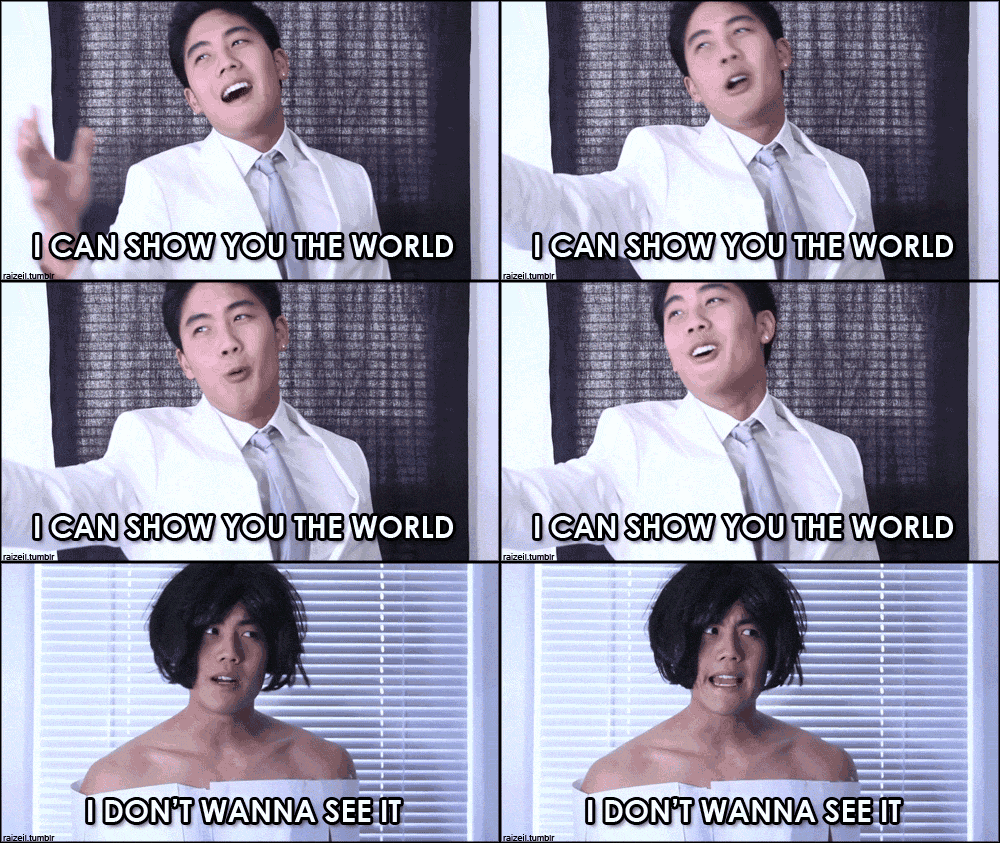
My minor characters are also busy:
 |
| "I'm sorry, are you having an emotional conflict? I can't hear you over the sound of how awesome I am." |
What's great about minor characters is the amount of freedom you have. Maybe you just need one around as a benchmark for how much your protagonist has changed, but don't let that stop you from making them awesome. My favorite dude in this manuscript is my main character's father-- I love snarky, angry people, and this guy is such a guilty pleasure to write that whatever scene he comes into he pretty much steals the limelight (and all the olives out of the fridge).
Taking another look at diversity.
The story I'm revising is a contemporary taking place in the present. I want to be sure that my manuscript accurately reflects the people you'd find if you went there-- whether it's the race demographic or LGBT characters. And yeah, I'm a white, straight girl trying to write characters that aren't those things. I'm really nervous about messing up. I'm completely prepared for someone to tell me that I'm doing everything wrong, and that I am exactly zero, none, no good.
 |
| my feels |
But more than I'm anxiety-attacking about offending every person ever, I know I can write human beings. I can write angry people (see hilarious angry father a few paragraphs ago). I can write serious, pragmatic, but secretly goofy people, and I can also write happy people hiding a deep sadness. I can research my heart out. And maybe (probably) I won't get it exactly perfect, but I'd rather try than stop myself because I'm too afraid I'll fail.
Revisions are my time to tighten up character identities and push myself. If you're also writing diverse characters, needing/wanting ideas or help, and not yet checking out the cool stuff that Diversity in YA is doing, get on that! They are awesome. :)
Beat management-- aka, no one shakes their head that much in real life.
I love my dialogue tags, but a lifetime of watching TV shows has made beats an integral part of my writing. I swear, most of the things that I am cutting out of this manuscript are "She nods." or "He blinks." Don't get me wrong, I love beats. But relying too much on the quick, two-word ones sometimes makes your poor characters end up like this:
 |
| "But you need to know it's me doing the speaking, so here you go." |
I feel like I'm writing the reaction gifs of my characters sometimes, and sometimes that needs to get pared down or re-modded. I really like having my characters do things while they're talking, so I can use the beats to have them accomplishing different tasks-- like putting a straw into a juice carton or climbing up trapdoors-- instead of always nodding along or staring incredulously.
Research is fun. Also, addictive. Also, the internet is scary.
I've never been to the city where my manuscript is set, but I have Google Maps'd that place and gotten an idea of the local layout. I've researched weather conditions, local landmarks, and cool places for the characters to explore. Have I gone on streetview along neighborhoods to get an idea of what it looks like to walk through it? Yeah. Have I picked out a real house I think would be totally perfect for my main character? Yes.
Is it creepy and insane that we have the technology for me to do this?

Cut the superfluous stuff and get to the magical cookies.
Susan Dennard has a great post on this-- pretty much, if you're not excited to write a scene, your readers aren't going to be excited to read it either. It's like you're constantly at war for being the most awesome thing on your reader's mind.
Kill every darling.
Slay them. If it sounds cute, it gets cut. I keep my cuts in a separate document (which is how I'm keeping track of my word count for NaNo), so it's not like any darlings are killed forever. But more often then not, when I read through things in my cuts doc I can see why they were too weak to stay in the draft. If it can't hold its own in the manuscript, if my liking it is the only reason it's in here, then it has no place in the final version. It's tough love, but it's making the story better.
 |
| Any darlings left must be at least this fabulous. |
And that's my report from revision land. How are your NaNoWriMo projects going, guys? Or if you're revising like me, share your favorite tricks for gettin' it done. :)

When Alex Yuschik isn't writing her next YA novel, she's working on someone else's as an intern at Entangled Publishing. She writes about lock picks, ghosts, the abandoned places in cities, and how not to strike bargains with stars. Between sneaking in time to game and rocking out to indie music, Alex spends the rest of her free time working towards her PhD in mathematics. You know, as one does.

You can find her on Twitter @: http://twitter.com/alexyuschik
Or drop her an email at: alex.yuschik@gmail.com
And also visit her website @: alexyuschik.blogspot.com


