Showing posts with label Revising. Show all posts
Monday, December 8, 2014

Rainbow Revising

November is dead and NaNoWriMo is over, and now you're probably left with a lumpy, shapeless manuscript that you're not sure what to do with. I hear you. I've been there, and I'm still there now.


The answer is color-coding. (I personally think the answer to everything is color-coding, but whatever.)

I've recently started doing something I call Rainbow Revising, in which I read through the manuscript and tag or highlight portions that relate to a certain aspect, and then go back and change them in the order of the rainbow. (I also like to be passive-aggressive and tell my manuscript to "TASTE THE RAINBOW" when I'm doing it. It's good to get the feels out.) The whole system is effective, and has cut my revision time in half since I started using it. Here are the colors you're looking for:

Red: Main Character
Orange: Secondary Characters
Yellow: Plot
Green: Setting
Blue: Tension
Indigo: Word Choice
Violet: Grammar, Spelling, Punctuation


1. ROYG-ify your manuscript. Read through as many times as it takes to highlight or tab the first four colors only. Those are the big points you're trying to hit and that need to be taken care of before you start worrying about the cool colors on the spectrum. So when you're looking for main character, highlight the thoughts, beliefs, and actions that influence your manuscript's direction. The same goes for the secondary characters, the ones that are essential to the story. Then thread through and find important plot points, and when your setting is described.

2. Red alert! Out of all these colors, red is the most important and the one that needs to be sorted out first. Your character should be directly influencing all other elements of your manuscript, so you need to be clear about how she thinks, what she believes, and how those two things influence her decisions. Go back through your red tabs/highlights and ask yourself if every action and choice make sense based on what your character wants and who she is. You'll find as you do this, how your secondary characters see her (orange), plot points (yellow) and how she uses and sees her natural surroundings (green) will also change. This is awesome; less work for clearing up one color! Once you think you've got red covered, take a few more passes through orange, yellow, and green to make sure they still line up.

3. BIV it up. Now it's time for the silky blues and deep purples of the visible light spectrum. Here's where you do your nitty gritty micro-writing. Take a look at each chapter, and then each scene, and check for tension (hint: there should be some in each one). One question you can ask yourself during each scene is: What's at play here, and how can I make sure the stakes are apparent to the reader? After that, go back and polish those pronouns and punctuation and make this thing sparkly.

I'm not saying this is the end-all, be- all to manuscript revision. In fact, you may need to make your book taste the rainbow in another pass after this one. But it's a concrete system that give you something to start with, which I think is important when you first get going.

How 'bout you, Secret Lifers? Do you color code when you revise? Or what are some of your favorite revision techniques? Share the wealth in the comments!

Andrea Hannah writes about delusional girls, disappearances, and darkness with a touch of magic. When she's not writing, Andrea runs, teaches, consumes epic amounts of caffeine, and tries to figure out how to prevent her pug from opening the refrigerator (unsuccessful to date). She's represented by Victoria Marini of Gelfman-Schneider/ICM, and her debut novel, OF SCARS AND STARDUST, is out now. You can add it on Goodreads here!

You can find her on Twitter @: http://twitter.com/andeehannah

Drop her an email @: andreahannahbooks@gmail.com
And visit her website @: http://www.andreahannah.com/
Friday, March 14, 2014

Tips for Using Scrivener to Revise Your Novel

Hey, lovelies!

I'm back in the revision cave (again). I've been working on this book on and off for over a year now, and let me tell you, it's been a tough one. The first few drafts were just me trying to sort through the plot, and now I'm finally at the point where I'm tightening everything up. This is the last draft. I swear. For real this time.

Anyway, seven drafts later, I've learned a thing or two about how to maximize my efficiency when I'm revising or rewriting. Here are some tips for using the gloriousness that is Scrivener to help you finish that draft and not lose your mind.


1. Start a fresh document
I generally draft in Scrivener and revise in Word, so I already have a Scrivener doc with my entire manuscript. However, for this purpose, I'm going to start a fresh Scrivener doc and label it something like Manuscript Title_Revisions.

2. Make a separate section for each of your chapters. 
If you take a look at my screenshot above, you can see that I've added in (some of) my chapters on the left. I've also added in an old outline doc, and a brainstorming doc at the bottom.

3. Organize your thoughts within the chapters.
The first thing I do is take that snippet of my old outline (see the top of that doc) and put it in the appropriate chapter. I make an outline for every draft that I finish, just because it helps me to easily see the whole picture when I'm revising for big ideas and themes. Anyway, I put in that old outline at the top so I can see where I'm coming from before I get to where I'm going. Then I re-read the old chapter.

After that, I make two sections: Notes and Darlings. Notes is the place where I dump all of my thoughts, where I talk through revisions ("Okay Andrea, you're a nut ball. What were you thinking? None of this makes sense.") and where I make notes on things that need to change. The chapter in my example is a fun, light chapter and therefore is pretty light on the revision. Some (okay, most) of my chapters are filled with tons and tons of notes.

Darlings is the place where I put any of my old writing I've cut that I think I may want to use, if not in this chapter, later in the manuscript. Mostly this is important information that needs to show up somewhere in this book, I just know it's not supposed to go in this chapter anymore, so I'm holding onto it until I know what to do with it. I also use Scrivener's keyword function to help me find those darlings later when I need them.

Overall, this makes it easier to find everything I'm looking for, and to go back and see my thought process for each chapter. This way, when I'm re-reading my manuscript later and I notice something that doesn't make sense, I can go back to that chapter in Scrivener, see what I was thinking, and change accordingly.

I hope that helps! How do you guys revise? Do you use Scrivener, or do you have a different process?

Andrea Hannah writes about delusional girls, disappearances, and darkness with a touch of magic. When she's not writing, Andrea runs, teaches, consumes epic amounts of caffeine, and tries to figure out how to prevent her pug from opening the refrigerator (unsuccessful to date). She's represented by Victoria Marini of Gelfman-Schneider/ICM, and her debut novel, OF SCARS AND STARDUST, is coming from Flux in Fall 2014. You can add it on Goodreads here!

You can find her on Twitter @: http://twitter.com/andeehannah
Drop her an email @: andreahannahbooks@gmail.com
And visit her website @: http://www.andreahannah.com/
Monday, November 25, 2013

Ira Glass on Writing: the Pep Talk Remix (feat. Revisions)

I'm in the heart of Revisions City and it's nuts. Half of this weekend I've wanted to chuck this draft, and the other half I've been like WAIT SUCH A GREAT IDEA

Welcome to writing, amirite?

So today I'm pep talking, because I need a little reminder that there is light at the end of the scene-shifting reviso-tunnel. Maybe you do, too. If so, pull up a chair and grab a chocolaty holiday beverage, because this is about to get real. *cracks knuckles, grabs mic and turntables*

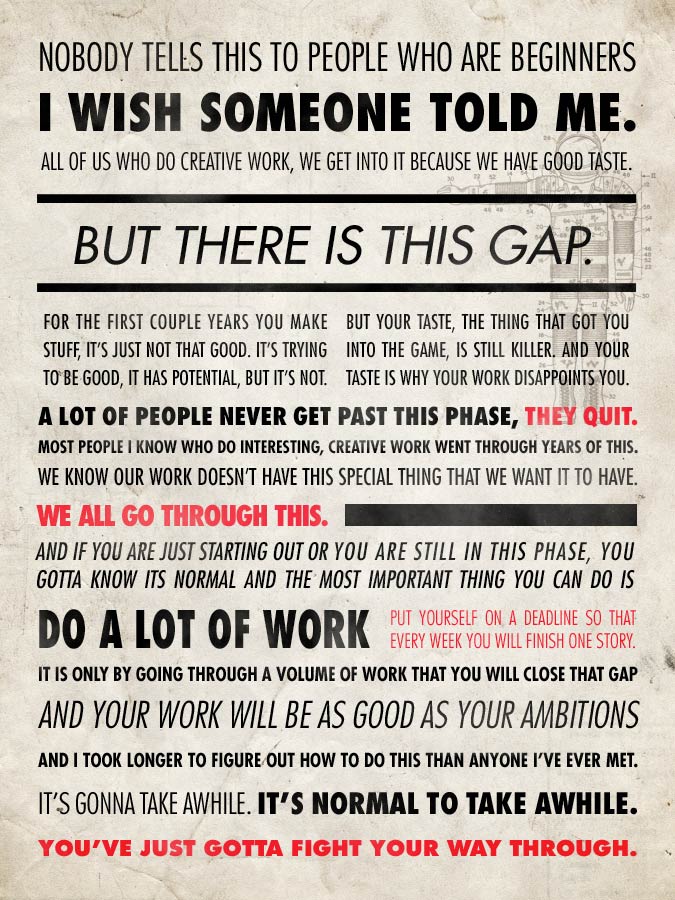
I know most of us have probably seen this great thing Ira Glass said, but if you haven't, have a gander below:


This is probably my favorite thing that anyone has ever said about writing. What I also love about this quote is that is pretty much perfectly gets my feels on the revisions process. With a few word substitutions, we have --voila ici-- a revisions pep talk. *disco ball and strobe lights engage* 

For the first couple of drafts, it's just not that good. 
There are some people out there who are capable of producing clean first drafts. But for the life of me, I am not one of them. I'm tempted to believe that these people are unicorns because the drafting process to me is just so much ceremonial bloodletting that it's hard to believe that a whole draft could come out okay. I like unicorns and would love to someday metamorphose into one; I'm just not there right now.

Because right now, all I can see is the gap between where this draft is and where it needs to be, and it's daunting.


There's a reason why NaNoWriMo tells you not to be afraid of things sucking. Sometimes it's got to suck so that you can see where the piece as a whole is going. This happens in math a lot too-- something you have to play around with the whole problem and it gets really ugly before you get that golden idea, that strategy that lets you solve it.

So, don't sweat the sucky parts. You'll figure them out eventually.

We know our manuscript doesn't have this special thing that we want it to have. We all go through this.
 It happens to everyone. Even Ira Glass. The verve, the magical kaiju bone powder, the ambrosia, the essential lightning is gone, its switch is flicked off. We are the overly enthusiastic buffaloes-on-trampolines of the world, and it's just Not Happening.


A very wise CP of mine has said that each draft is ruled by a certain part of you. The first draft is the gut draft-- you want the emotional punch and swing, you set up the schematics for the roller coaster ride you plan to take your reader on. The second draft you write with your head. You make sure that things make sense, you correct your goofy spelling errors, and you solidify characters. The third draft you write with your heart. Here you marry the emotional gut-punch to the cerebral awesomeness that you added in during draft mach two.

Let draft uno do its thing. Fix the weirdo stuff in the brain draft, and then tie everything up with the heart draft. Just know that no one expects you to nail it 100% the first time through.

And if you're just starting on a first draft or you're still feeling this in revisions, you gotta know it's normal and the most important thing you can do is do a lot of work. 
Writing advice can be all over the place. Some people will tell you to do one thing, others tell you to do the opposite. Ultimately, it's about being familiar with whatever you're doing, feeling comfortable enough with your tools as a creator of stuff, and using them to their best advantage. And you get that level of comfort by working on a draft a whole lot. 

So, go do that. 

Maybe you want to write impressive fanfiction stories to work on character development without the weight of creating a world that works on your shoulders. Maybe you want to chill with some poetry and work on how words interlace. Maybe you want to map out your world. Whatever it's going to take for you to have a better handle on your work, go for it.

The more you do it, the better you get.

Put yourself on a deadline so that every week you finish a chapter, or every month you nail a revision, or whatever works for you. Hold yourself accountable and finish things.
It's not going to be pretty. In fact, it's probably going to get uglier before it gets better. But still, you've gotta keep moving.


You're a writer, and you write. You're not an okay-let's-go-oops-wait-giving-up-now-er. You write, so figure out how to work writing into your schedule. Maybe every day works for you and you love waking up early. Maybe it really really does not work for you, but you find that when you have five or six dedicated hours, you rock it. Whatever. Somehow, write.

It's only by going through a volume of work that you will close that gap and your manuscript will be as good as that vision of it you have in your head. 
We humans are fallible. And that's okay. If I can make something better each time I pass through the manuscript, then awesome. It's better than it was before.

Sometimes it's going to get 75% better. Sometimes it'll be a measly 38% or even only 6% if it's an off day. Sometimes you're going to rock it and a scene is going to be 100% more awesome than it was. But hey, all these things are great. Why? Because in some way, large or small, your draft is getting better-- it's incrementally inching towards the place you want it to be. So don't knock yourself if it's slow going, even though it's wicked tempting, even if you only change like three words because you haven't figured out totally where your characters are going.


You made something better, even if it was small. Your draft is better for it, and closer to where it needs to be. Give yourself a pat on the back (and eat some chocolate, dude, because that is never not sage life advice).

It's gonna take a while. It's normal to take a while.


It feels like it is literally one of my CPs weekly duties to gchat me telling me it takes as long as it takes for this revision. (Related: if you're reading this, hi you are a saint.)

And you know what? As much as I give myself grief for being the slowest of the slow with respect to pulling this mega-zord of a manuscript together, I know when it's done it's going to be pretty cool. And I know that when your drafts are done, gentle readers, they too will kick much ass. Because, as Ira Glass says:

You've just gotta fight to fight your way through.


When Alex Yuschik isn't writing her next YA novel, she's working on someone else's as an intern at Entangled Publishing. She writes about lock picks, ghosts, the abandoned places in cities, and how not to strike bargains with stars. Between sneaking in time to game and rocking out to indie music, Alex spends the rest of her free time working towards her PhD in mathematics. You know, as one does.

You can find her on Twitter @: https://twitter.com/alexyuschik
Or drop her an email at: alex.yuschik@gmail.com
And also visit her website @: alexyuschik.blogspot.com 
Monday, November 11, 2013

Revision Tools from Alex's Nano Rebellion

Hey guys! Hope writing's going well, especially if you're doing NaNoWriMo. :)

For my NaNo project this year, I'm trying something new. Instead of writing 50k words in a first draft, I'm cutting and rewriting 50k words in the manuscript I've been revising.


It's been challenging to get through the first week, but revising under time pressure has taught me a lot about my own editing process, so I'm sharing what I've learned thus far. Whether you're rebelling and revising with me, revising as you write, or looking for ideas for December's edits, hopefully there's something in here that can help you out.

When I use a feeling by name, I double-check that I'm not telling in that sentence. 
One of the really awkward things about revising is reading over all the stuff you thought was super hot, and then cringing when you spot all the telling you're doing. Naming emotions tends to get me into trouble. Unless you're doing an awesome take on feelings like Kelsey and personifying emotions *obligatory Fear fangirl moment* or inside a character's head, dialoguing, or something to that effect, then chances are these emo-nouns are telling where there needs to be showing.

And when you start looking for them, it's kind of intimidating. Because they're EVERYWHERE.

oh god not you again
Most of the adverbs that I cut are things like "angrily" or "quizzically" or "vehemently"-- all of which aren't that needed if I'm making my dialogue convey the rage, confusion, or urgency it should. Sometimes it's fine (my rule of thumb is that in dialogue anything goes), but I don't want things like "His fear was becoming suffocating." or "Love wasn't something he had time for." making it to the next draft. That's the telling that I want to get rid off.

Minor characters are where it's at.
One of my CPs and I regularly geek out over how awesome minor characters are. Why? These are people you added to your story to accomplish a certain function, but in true writerly sleight of hand you can't let the reader know that. So, you do the only thing you can do, which is to make them utterly amazing and hilarious.

While my main pair is busy with their own problems:


My minor characters are also busy:

"I'm sorry, are you having an emotional conflict? I can't hear you over the sound of how awesome I am."

What's great about minor characters is the amount of freedom you have. Maybe you just need one around as a benchmark for how much your protagonist has changed, but don't let that stop you from making them awesome. My favorite dude in this manuscript is my main character's father-- I love snarky, angry people, and this guy is such a guilty pleasure to write that whatever scene he comes into he pretty much steals the limelight (and all the olives out of the fridge). 

Taking another look at diversity.
The story I'm revising is a contemporary taking place in the present. I want to be sure that my manuscript accurately reflects the people you'd find if you went there-- whether it's the race demographic or LGBT characters. And yeah, I'm a white, straight girl trying to write characters that aren't those things. I'm really nervous about messing up. I'm completely prepared for someone to tell me that I'm doing everything wrong, and that I am exactly zero, none, no good.

my feels

But more than I'm anxiety-attacking about offending every person ever, I know I can write human beings. I can write angry people (see hilarious angry father a few paragraphs ago). I can write serious, pragmatic, but secretly goofy people, and I can also write happy people hiding a deep sadness. I can research my heart out. And maybe (probably) I won't get it exactly perfect, but I'd rather try than stop myself because I'm too afraid I'll fail.

Revisions are my time to tighten up character identities and push myself. If you're also writing diverse characters, needing/wanting ideas or help, and not yet checking out the cool stuff that Diversity in YA is doing, get on that! They are awesome. :)

Beat management-- aka, no one shakes their head that much in real life. 
I love my dialogue tags, but a lifetime of watching TV shows has made beats an integral part of my writing. I swear, most of the things that I am cutting out of this manuscript are "She nods." or "He blinks." Don't get me wrong, I love beats. But relying too much on the quick, two-word ones sometimes makes your poor characters end up like this:

"But you need to know it's me doing the speaking, so here you go."
I feel like I'm writing the reaction gifs of my characters sometimes, and sometimes that needs to get pared down or re-modded. I really like having my characters do things while they're talking, so I can use the beats to have them accomplishing different tasks-- like putting a straw into a juice carton or climbing up trapdoors-- instead of always nodding along or staring incredulously.

Research is fun. Also, addictive. Also, the internet is scary. 
I've never been to the city where my manuscript is set, but I have Google Maps'd that place and gotten an idea of the local layout. I've researched weather conditions, local landmarks, and cool places for the characters to explore. Have I gone on streetview along neighborhoods to get an idea of what it looks like to walk through it? Yeah. Have I picked out a real house I think would be totally perfect for my main character? Yes. 

Is it creepy and insane that we have the technology for me to do this?


Cut the superfluous stuff and get to the magical cookies. 
Susan Dennard has a great post on this-- pretty much, if you're not excited to write a scene, your readers aren't going to be excited to read it either. It's like you're constantly at war for being the most awesome thing on your reader's mind. 

Kill every darling. 
Slay them. If it sounds cute, it gets cut. I keep my cuts in a separate document (which is how I'm keeping track of my word count for NaNo), so it's not like any darlings are killed forever. But more often then not, when I read through things in my cuts doc I can see why they were too weak to stay in the draft. If it can't hold its own in the manuscript, if my liking it is the only reason it's in here, then it has no place in the final version. It's tough love, but it's making the story better. 

Any darlings left must be at least this fabulous.

And that's my report from revision land. How are your NaNoWriMo projects going, guys? Or if you're revising like me, share your favorite tricks for gettin' it done. :)


When Alex Yuschik isn't writing her next YA novel, she's working on someone else's as an intern at Entangled Publishing. She writes about lock picks, ghosts, the abandoned places in cities, and how not to strike bargains with stars. Between sneaking in time to game and rocking out to indie music, Alex spends the rest of her free time working towards her PhD in mathematics. You know, as one does.


You can find her on Twitter @: http://twitter.com/alexyuschik
Or drop her an email at: alex.yuschik@gmail.com
And also visit her website @: alexyuschik.blogspot.com 
Friday, August 23, 2013

The Fast Way to Revise

Hi, lovelies!

Today I'm going to talk about how to revise your novel the fastest, most efficient way possible.

Right about now you're rubbing your hands together and cackling and maybe even sending me virtual kisses or cookies because who the hell likes revising forever? And right about now is where I disappoint you.

I'm going to tell you how to be efficient about it, and as fast as possible. But "fast" is a relative term, and it's going to depend on the depth of your revisions, and how fast your personally work. I'm just here to give you a strategy.

I've spent the past six months with stale material. I haven't written anything new since December, and I've been working on revisions for two separate novels pretty consistently. Part of the problem was that both required rewrites and both were novels I hadn't touched in awhile, so I had to reacquaint myself with them. The other problem was that I didn't have a method. There was a lot of writing notes to myself to change things or question things in my second (or bajillionth) re-read. There was color-coding. There was printing the whole thing and reading it through. All of these things were helpful, but not as efficient as I'd like them to be.

So I did this on my last two rounds of revisions and it was much, much faster.

The Big Changes:
This is where I knew I needed to change entire subplots or plot points, or I needed to rearranged the entire middle of the story. The first thing I did was write a synopsis of each chapter the way it was before I started. It wasn't very lengthy, just a few lines. Something like:

Chapter 8: Wren breaks into Mercers' house, steals the shield. Notices it's made of plastic, fake jewel falls off on her way to David's. 

I printed those suckers out and cut them up. Then I put them on my magnetic whiteboard (you can also use your fridge, or floor, whatever) and moved them around until they made sense. I cut them so there was a lot of extra space on both sides, and I wrote on them. I scratched things off. I made notes for myself. I stared at them until I was sure they were in the right order.Then I taped them back together and scanned them into a PDF so that I could have my new (messy) outline hanging out on my desktop while I wrote.

The Small Changes:
Pretty standard, right? I've head that advice before—to cut things up and write a synopsis and move things around, blah blah. The reason I'd never done it before was because it seemed like a whole lot of freaking work. And it is. It definitely is. But I was at the point where I'd rather just get it right this time instead of having to go back...again.

So anyway, once I got that under control it was time to take care of all the small things, the stuff you don't realize you're going to have to change until you've made the big changes. For me, since I had moved so many chapters around and all of those chapters had clues in them, I had to do quite a bit of rearranging of my characters' thought processes. Like if in my new draft they don't find the shield until Chapter 8, but in the old draft it was Chapter 2, then I need to change how they're coming to their conclusions and how they're moving the story along until they do find the shield. In the past, I would just type a little note in the margin to look at that later, something like "Wren needs to notice the shield earlier in the book." Good call, Andrea. I know there's a snafu, but I haven't identified how to fix it or where exactly it should go. So, I started doing this:

Open up a fresh Word doc. Make it into three columns. Label them Act I, II, and III (or Beginning, Middle, End. Whatever works for you). Let's say you come across something that needs to change in the middle of your book, Chapter 15. It's something like "David doesn't know that Wren's seen her chart yet, put that earlier." Well, here's where you're going to do all your thinking. Go back to your messy outline you made when you were revising the big stuff, and decide right then where that information could go. You could even give yourself options. For the purpose of this example, let's say Chapter 3. Go to the first column in your Word Doc (the "Beginning" column) and type yourself a specific note, something like "Ch 3. - Wren tells David she's seen her chart. Possible put after conversation with Joey."

As you find more and more small things that need to change, go ahead and try to figure out where they go right then and write yourself a note for the chapter they will go in. When it's all said and done, you can order them if you want. What you'll have is a nice little list, in order, of all the changes you need to make, what you're going to change, and where specifically it's going to go. I did really well with this method because it helped me organize my functions as a writer: the thinking/problem-solving function, and the writing function. I did all my problem-solving beforehand (and it got easier as I went through the chapters because I was already in that mode), and then I could just go through and fix things much, MUCH faster.

Hope that helps, Secret Lifers. Happy revising!


Oh, and if you haven't heard: we're looking for new members! Check out our post here for the details. You only have until Monday to apply!


Andrea Hannah is a YA writer represented by Victoria Marini of Gelfman Schneider. She writes stories about criminals, crazy people, and creatures that may or may not exist. When she's not writing, Andrea teaches special education, runs, spends time with her family, and tries to figure out a way to prevent her pug from opening the refrigerator (still unsuccessful). Oh, and she tweets a bajillion times a day, mostly about inappropriate things.


You can find her on Twitter @: http://twitter.com/andeehannah
Drop her an email @: andeehannah@gmail.com
And visit her website @: http://www.andreahannah.com/