Showing posts with label writing advice. Show all posts
Monday, November 24, 2014

The Secrets to Co-Writing a Book

I feel a tiny bit deceitful writing this post. First, the title implies that I've co-written many books before, and second, that I have some kind of formula for being successful at it. Neither of those things are true.

I am, however, currently co-writing a book. And I have, however, learned a lot about what works and what doesn't through our many stops and starts along this path to our almost-finished first draft. I figure, why not share those now before you get started with your partner instead of starting and stopping a million times like we did? So, I bestow you with my sorta-kinda wisdom of co-authorship:

Pick the Right Partner. I know, I know. This seems like a no-brainer. But you'd be surprised how many partnerships fail when they stretch from "just friends" into "business partners" territory. And that's really what co-authoring a book, is: a business plan. It's our intent to write a marketable book, present it to our agents, and sell it. This is a business transaction, and then it's a friendship. That means you need to pick someone that has a writing style that gels with yours, who works in the same manner you do, has similar goals for the story and the finished product as you do. And, most importantly, will be honest with you and you're comfortable showing your very crappy rough draft work to. But underneath all that, there's the friendship element that matters too: Do you genuinely enjoy this person? Do you like talking to them, outside of book-related things? Do you feel like this person is caring and understanding of your life situations, if by chance you won't be able to make a writing deadline you set? Both of these elements matter. Choose wisely.

Sign a Co-Authorship Agreement. My partner and I are still working out the details of this, but basically: put something in writing. It doesn't matter so much during the drafting phase, but as you get into the publishing phase, you'll need to set some terms. What if you sell the book and then one of you wants to back out? What if only one of you can't make the publisher's deadline, so the other picks up all the slack and then you both get the same cut of the money? These are all possibilities. Life happens. It's important to protect yourself, your friendship, and your work.

Create a System That Works For Both of You. One of the reason why our first plan to co-write crashed and burned was because we didn't really have a system, or at least not one that made sense. We shared a Google doc with our story, and then we'd text and email each other our thoughts as we went. This did not work, for obvious reasons. Texts get deleted, emails get lost in the void, and stuff did not turn out the way either of us thought. If you're going to have two people with two totally different brains writing a story, you have to get organized. We still have our massive Google doc where we keep adding on chapters, but we also have a folder with separate docs for each chapter. After one of us writes, we'll also create a new doc for the chapter we've finished and jot down our general thoughts, where we think the story is going, and notes about what we'll need to fix in revisions. We also go back and comment on each other's notes before we write the next chapter to clear up any confusion. So far, this has worked well. It's allowed us to still dialogue about our story, but all of our notes are in the same place and will be easy to sort through in the revision stage.

Find a Pace and Keep Going. Momentum is crucial here. I'd say it's even more important with a co-authored project than one you write on your own because you're building off someone else's ideas. When I sit down to write after my partner's finished a chapter, it takes me longer to get back into the project because I have to re-read her chapter, notes, thoughts, and try to put myself into her head before I keep going. Imagine trying to do that when it's been a week since you've worked on this story. You lose passion for the story quickly. For us, it's been important to set a deadline that works for both of us. We started with a 24 hour chapter turn-around, but bumped it up to 48 hours. I have small kids at home, and sometimes it's just damn impossible to get a chapter done within 24 hours. It works better for each of us to have 48 hours to finish a chapter and get it up on the doc, and it's still at a pretty fast clip so that we don't lose our momentum.

With these systems in order, it has been such a blast writing this book with my partner. When you're organized about the nitty gritty stuff, you can allow the magic to happen. Her brain works so differently than mine and it's been fun to watch the direction she'll take the story in before I pull it back in my direction. And bonus: it's created natural tension in the plot, which is awesome.

Have you co-written a book before? Am I missing anything? What system did you put into place to help get you through?

Andrea Hannah writes about delusional girls, disappearances, and darkness with a touch of magic. When she's not writing, Andrea runs, teaches, consumes epic amounts of caffeine, and tries to figure out how to prevent her pug from opening the refrigerator (unsuccessful to date). She's represented by Victoria Marini of Gelfman-Schneider/ICM, and her debut novel, OF SCARS AND STARDUST, is coming from Flux in Fall 2014. You can add it on Goodreads here!

You can find her on Twitter @: http://twitter.com/andeehannah
Drop her an email @: andreahannahbooks@gmail.com
And visit her website @: http://www.andreahannah.com/

Thursday, November 20, 2014

5 #Subtips from Debut Author and Editor Kate Brauning

Hey Secret Lifers-- Alex here. My CP Kate Brauning just released her debut, HOW WE FALL, a week ago, and she's here sharing some of her secrets with us about writing and revising today. Her book's fantastic, she's one of the coolest people I know, and she has an amazingly content Siberian husky named Charles (who I got to pet when I visited!! ahh! such fluff).

Take it away, Kate!


With my debut novel How We Fall just having been released, I’ve been asked to share some of the things I’ve learned in the past few years as an editor and author.

1)      Keep writing. When you’re querying, when you’re on submission, keep writing. Having another project to put your energy into is a great way to help balance the nerves, waiting, and stress that goes along with publishing. Plus, if you decide to shelve that manuscript, you’ll be well on your way to having a new one completed, and if you do land an agent/book deal, having another project nearly ready is great.

2)      Trust your ability to rewrite. Holding too tightly to sentences and paragraphs and ideas in my manuscripts held me back more than almost anything else. Someone once told me that if I can write one good line, I can scrap it and write another, and if I can have one good idea, I can come up with a second. Doing what’s best for the story and the prose and not keeping myself locked in to something just because I’m proud of it is essential to being a good writer. That’s been a huge factor in reducing the stress of revisions. If you’ve done it once, you can do it again.

3)      Don’t expect your first draft to be magical. Don’t get discouraged when you’re drafting if you’re not seeing magic happen. That magical touch and those insightful moments you see in great books aren’t magic at all. They’re the result of blood and sweat. First drafts are limp and flat and awkward—that’s normal. The depth and layers come as you revise. And revise. And revise.  

4)    Focus on your own writing. When I was querying, it was sometimes a struggle to not be jealous when someone else signed with an agent. When I was on submission, it was hard to not be jealous when someone else landed a book deal. Even though I was happy for my friends, it often made me wonder if it meant I wasn’t as good because it hadn’t happened for me yet. And now that I have a book out, there are other authors’ awards, bestseller lists, and publicity and buzz I could be worrying about. But no one else’s success diminishes mine. One of the most wonderful things I’ve been realizing as I find critique partners and connect and blog with other authors, particularly in YA, is that we’re much more colleagues than competitors. Readers can pick up my book, and they can pick up someone else’s, too. Another author’s success doesn’t limit or detract from mine. What does limit my success is me looking at someone else’s plate, and wishing I had what they had, and letting my own work suffer.

5)      Think of writing and the publishing journey as pursuing any other career. Study, learn from experts, network, study more, practice, take constructive feedback, and work, work, work. Writers sometimes have the expectation that it should take maybe a year to write and revise a MS and a year to get the querying process figured out, query, and hear back. Either way, 2-3 years is about the time we expect to have an agent and be on submission if we’re any good. I don’t think that mindset is accurate or always healthy. Writing is a competitive, demanding, detail-oriented, incredibly complex career. No other career like that gets off the ground in 2-3 years. It takes more than that to become a teacher, lawyer, engineer, graphic designer, or doctor, and even then, most of them have to work their way up. You haven’t failed and you aren’t a bad writer just because your journey takes longer than someone else’s. Treat it like a long-haul career both in your expectations and your work habits, because you are the biggest factor in your career.

Ever since Jackie moved to her uncle’s sleepy farming town, she’s been flirting way too much–and with her own cousin, Marcus.

Her friendship with him has turned into something she can’t control, and he’s the reason Jackie lost track of her best friend, Ellie, who left for…no one knows where. Now Ellie has been missing for months, and the police, fearing the worst, are searching for her body. Swamped with guilt and the knowledge that acting on her love for Marcus would tear their families apart, Jackie pushes her cousin away. The plan is to fall out of love, and, just as she hoped he would, Marcus falls for the new girl in town. But something isn’t right about this stranger, and Jackie’s suspicions about the new girl’s secrets only drive the wedge deeper between Jackie and Marcus–and deepens Jackie’s despair.

Then Marcus is forced to pay the price for someone else’s lies as the mystery around Ellie’s disappearance starts to become horribly clear. Jackie has to face terrible choices. Can she leave her first love behind, and can she go on living with the fact that she failed her best friend?


Kate Brauning grew up in rural Missouri and fell in love with young adult books in college. She now works in publishing and purses her lifelong dream of telling stories she'd want to read. This is her first novel. Visit her online at www.katebrauning.com or on Twitter at @KateBrauning
Friday, October 24, 2014

Setting is a Ghost

So I've been trying to think up things that fall under the categories of "secrets," "Halloween-y," and "cool, hopefully useful writing knowledge" but most of what I've got is: well, I traveled a bit this summer. 

You got me-- it's not really a secret and not useful writing advice. It's not even Halloween-themed.

But I can talk about setting. 

BALCONIES maaaan I love balconies
Over the summer, I went to New Orleans and it was kickass. I had a scene in my last manuscript set there, and I really wanted to capture as many details of the city as I could. I'd never been that far south before, and while I'd done a ridiculous amount of research on the city and the culture before visiting, it was still really interesting seeing what stood out about a place versus what I was writing about it. 

Setting, in many ways, is like a ghost. It follows you through the pages of a book. It never contacts you explicitly or anything, but you see traces of its presence as the characters go about their business-- balconies housing dangling plants, strings of lights, and deck chairs, and the rank oyster smell loitering outside some of the bars and restaurants. 

PALM TREES IN ACTUAL REAL LIFE 
As a reader, I love seeing the ways that a book's setting influences the plot. As a writer, I subscribe to the idea that the setting has to be integral enough to the book that the story can't be set any other place and still be the same thing

I visited the French Quarter during nights when it wasn't even Mardi Gras (aka the middle of May) and the streets still get closed to through traffic during the late evenings because the foot traffic is just that intense. It's crazy! And it's those weirdo, super-specific details that draw people in and make your setting a compelling one. 

Characters that are from certain regions of the country (or from different countries!) may also behave differently, or even if they don't adhere to their native region/homeland's mores, they'll still see a certain set of behaviors as normal/acceptable and others as rude. 

And it all comes from setting. 

fun fact: tiny birds will perch on your table here and try to eat your grits (not cool, bro)
The setting can also collude with you in making characters' lives harder. Protag need to go somewhere immediately? Have the cab get snarled up in traffic around a tourist trap or monument. Two characters gearing up for a fight? Find either the worst or most interesting place for them to do it-- what cool environment can they use in battle? 

In last ms, I had one character chase after another. Simple enough, yeah? Then I set that scene on Bourbon Street at night, and suddenly, tons of conflict: one character is breaking curfew, he can't see where he's going because there's too many people, his own personal phobias start kicking in, he gets cheap drinks spilled on him-- it kickstarts a whole mess of details and tensions. 

And you don't have to campy with it-- while I believe that details do help ground us in a setting, most of what a setting is is the feeling it invokes in us. A ghost's goal is to make you feel something. 

another fun fact: over half the pictures I took are balconies 
The specifics matter less. It's less important that there are foreboding knocks on the bedroom wall and more that the person sleeping there feels threatened (though obvs to do this, you'll want to include some specifics to show it). Ultimately, it's up to you to choose the details that stand out to you as touchstones of a location-- short, sweet punches that capture the essence of wherever your story is set. 

Especially in contemp, I think it's important to let the setting shine. Places, like ghosts, have their own histories. Nowhere stays the same forever.  

Same deal for fantasy--setting can add a unique spin and flavor to old tropes. What about your particular fishing village makes it an interesting/terrible place for the protag to grow up in? I adore Jodi Meadows' INCARNATE books for a ton of reasons, but one is that her world and setting are so interesting and constantly affect the characters. 

My current WIP is an urban fantasy and I'm researching geology, mine disasters, and all sorts of esoteric facts and beliefs about rocks for its monsters and magic system. I want the history of coal mining and those specific details associated with it to haunt my readers-- not beat them over the head with HEY COAL HELLO but to give that story a specific flavor.

And yeah, I had an awesome time in New Orleans and I promise I was not thinking about setting 100% of the time, though I did occasionally split off to wander Bourbon Street or prowl the WWII Museum. Moment of drooling for the memory of the beignets we consumed.

~*they were so good*~

And I got to meet Leah!! (You guys, she is every bit as amaze in real life as she is online.)

Leah's phone is also nine zillion times cooler than mine
So what do you guys think? What are some of the best examples of setting that you've come across in books? I also really adore ANNA DRESSED IN BLOOD and (duh of course) THE SCORPIO RACES and THE RAVEN BOYS for this as well. Share your favorites and we'll tweet recs through the day! :)

Alex Yuschik writes about lock picks, ghosts, the abandoned places in cities, and how not to strike bargains with stars. Between sneaking in time to game and rocking out to indie music, Alex spends the rest of her free time working towards her PhD in mathematics. You know, as one does.

You can find her on Twitter @: https://twitter.com/alexyuschik
Or drop her an email at: alex.yuschik@gmail.com
And also visit her website @: alexyuschik.wordpress.com 
Friday, April 18, 2014

How to Be a Writer and Keep Your Friends

If you're like me, then you probably stay home most days. Like, everydayyoupossiblycan. I've always been okay with being home by myself and not talking for hours, but over the last few years, I've gotten much worse. When I was single and living in Downtown Sacramento, it was easy to get away with staying in. People never really noticed, and if they did, they never really cared. Friends would bug me every now and again to go out, and I'd make up an excuse that involved not having money and such. Which was partially true. Actually, the no-money-thing is more true today than it was then, but anyway.

But I'm not that single-hermit-girl anymore. I'm married and have a husband who reminds me that I have to be a human being sometimes. I'm a daughter and a friend and a co-worker. I'm all these things to people who expect me to BE who they want me to be. I'm supposed to go out and have a good time and laugh and whatever else normal people do. I'm supposed to listen and react and say something that matters. But these things don't come easy for me. It's hard to explain to the outside world, but I know YOU understand, my friends.

Being a writer means there's always something needing to be done. There's always another chapter, or another deadline, or another shiny book idea. You're always thinking and plotting and itching to tap your fingers against the fading keys of your keyboard. Sometimes you're stuck on Act II and your characters suddenly come to life in your head and everything clicks! Sometimes you want to be able to drop whatever is it your doing and run home to flesh out the words, but you can't. You can't because you're supposed to be available. You're supposed to be human.

I forget that sometimes. I forget that I'm not the only person in my quiet little world. That I'm supposed to interact and show the people I love most that they matter. And just because I'm okay with being locked inside all day, every day, doesn't mean that my family and friends are.

So I force myself to go out. And, yes, I mean force myself. But not in a bad way, though it sounds that way. I have to tell myself that it's okay to let things go. For another day. Maybe two. Because even when that book has come to an end, it's the people on the outside waiting to share their stories with me.

I'm writing this for myself, and for you, as a reminder. It's easy for us to lose sight of the things that are the most important. Because even though that lingering deadline is staring us down like a fire-breathing dragon, we have to be able to battle it 'til the death, while still maintaining our muggle form.

So go out today, maybe even tomorrow (hell, why not both days!), and be a human being. There are so many story ideas out there, waiting to be discovered. We just have to leave our comfy little writing caves in order to find them.

Heather Marie is a YA writer who loves all things creepy. She enjoys writing horror/supernatural stories that make you question that feeling of someone watching over your shoulder. Heather spends most of her days reading and writing and plotting her next idea. When she's not in her writing cave, she enjoys watching creepy TV shows with her husband and picking apart plot holes in movies.

Her YA debut, THE GATEWAY THROUGH WHICH THEY CAME, releases August 25th, 2014 from Curiosity Quills.

You can find her on Twitter @: http://twitter.com/HeatherMarieYA
And visit her website @: http://HeatherMarieYA.com


Wednesday, April 16, 2014

A Love Letter to Readers

I've been up to my ears in work lately. And the end is not in sight. So, the anxiety monster has been poking his little head over my shoulder quite frequently. I've been fighting the "I sucks" on a regular basis. I'm always reaching out to my awesome writer pals and they're always there to cheer me on. But you know what really lights a fire under my ass? Readers.

Readers, bloggers, reviewers, all you lovely people who take the time to read those silly words I put down. To all of you who post reviews, be they one star or a billion. To all of you bloggers who put my book in your multitude of Top Ten lists, be it a Top Ten Rereads or your Top Ten "I don't get it"s. Can I just say THANK YOU! 


Sometimes I dread sitting down at my manuscript. On those days, all it takes is a kind word from a reader to get my fingers typing. And sometimes, all it takes is a one star review to get those fingers typing, too. Because I want to do better. 

They say, "Write for yourself." And there's a lot of truth to that, but I also think it's a good idea to find a balance. Yes, write for yourself, because if you don't love what you're doing, it's probably not going to turn out well. But I think we should also write for our audience. Give them what they want!

Recently there was a hashtag on twitter started by @ShaelynCherie called #RBWL or Reader Blogger Wish List. It's similar to the #MSWL (Manuscript Wish List) editors and agents do where they tweet what kind of stories they want to see, but I think #RBWL might be more important. These are requests from the people who really, really matter: THE READERS (sorry agents and editors). 

So, here's my writerly advice for the day. Whether you're published or aspiring, get to know your audience. Read their blogs, follow them on Twitter, start conversations and get their opinions. Because just like you want to write the best words you can, they want to read the best words you can write! They don't want to hate your book, they want to love it! 
Monday, March 10, 2014

Make it Hurt

credit: Cinema Fanatic

I watched Roman Holiday last night with my mum-- there's a local theatre showing some classics during the spring, and we caught this one. I forgot how much I liked it, both for the actors, but also its last scene.

It made me think about how much books and films get characterized by single moments that showcase character change. Harry Potter would not be Harry Potter without Harry walking to his death in book seven. The Great Gatsby wouldn't be the same without that scene where Nick is calling people from the wake, wondering where on earth people are.

But without the emotional build-up behind these scenes, what are they? Just a boy with a rock walking in the woods, and a man with a phone by a casket.

So too is it with any manuscript.

One of the neat things that being in poetry workshops and working with poems in undergrad taught me was to focus on an image. And yeah, oftentimes there's a particular scene that captures everything about your characters that have changed in a single perfect moment.

Come back to Roman Holiday. What makes this last scene hurt so much? Joe Bradley's just revealed to Princess Ann that he's a member of the press corps and that he's not going to publish his story about the fun times they had running around Rome yesterday, even though it would enable him to move back to New York and show up his boss.

His character has changed-- he knows who Ann is and, whatever his feelings are towards her, they've changed since he first found her on the park bench. She's no longer some royal kid he's happy to screw over for a quick buck.

What I love about the last scene, though, is how much the power dynamic has changed. All throughout their trip around Rome, it's always Bradley in control, following Ann places, setting things up with his photographer friend to score pictures of Ann in un-regal situations. In the last scene, it's Ann giving the press conference, meeting people, and then leaving. Bradley waits for her to come back out, but she doesn't. The holiday is over.

He walks the whole way to the end of the embassy hall by himself, turning back at the end to see if she's behind him before he leaves. She's not.

This is what a pivotal scene in a manuscript needs to do. It's got to show a character acting in a way that is different from how we meet them (Bradley gives up the money, Ann accepts the rigors of royal life) and punch us in the gut (having the power to destroy someone's life, where both you and the other person know it, it would be to your advantage, and then not).

The nice thing about these scenes is that you don't have to explain them-- it's your job for all the manuscript that comes before them to make them plausible, and then let the reader work it out on their own. All you have to do is lay the groundwork for the pivot point, and when the reader gets there, make it hurt.

When Alex Yuschik isn't writing her next YA novel, she's working on someone else's as an intern at Entangled Publishing. She writes about lock picks, ghosts, the abandoned places in cities, and how not to strike bargains with stars. Between sneaking in time to game and rocking out to indie music, Alex spends the rest of her free time working towards her PhD in mathematics. You know, as one does.


You can find her on Twitter @: https://twitter.com/alexyuschik
Or drop her an email at: alex.yuschik@gmail.com
And also visit her website @: alexyuschik.wordpress.com 
Friday, February 28, 2014

The Secret to Defeating the Guilt Monster

Hi, lovelies!

Today I'm going to talk to you about this epidemic I've been noticing in the publishing world ever since I started writing seriously a few years ago: Guilt, with a capital G.

I don't know how many tweets I've witnessed, or how many I've written myself, that include some version of "OMG I'M NOT WRITING I'M SUCH A SLACKER." I wrote one yesterday, for cripe's sake. (Note: old habits die hard.) Never mind that I've been teaching, raising two babies, taking care of my family, and finishing a graduate degree. No, all I could focus on was that I hadn't written a single word in a week and that I was a failure and a schmuck and that my writing career was going to shrivel up like an unwatered house plant.

But then I re-read this wonderful, brilliant advice my agent posted on her blog last month about the difference between procrastination and incubation, and it made me realize that I had no reason to be guilty at all. And you definitely shouldn't either.

Think about it: how many of us are constantly incubating our thoughts? Incubation is a tricky beast; it can look a lot like it's uglier sister, Procrastination, but they're not at all alike. How many of you daydream about your characters? Write down little snippets of dialogue in your phone? Smother your desk or car or refrigerator with stickies? I know you all do it. That's what writers do.

So all that time you're not writing down "a single word," you're actually writing down tons of words. In fact, you're probably writing down the most important words of all: the ones that touch you, inspire you. The ones that make you antsy to find time to sit down at that computer. One day. After the baby sleeps through the night or your finish that report for work or you get over that chronic head cold. That way, when you finally do have the time, you'll know exactly what you want to write.

In a way, incubation is actually pretty productive. 

Here's another thing to think about so that we can banish the guilt monster for good: the best stories are written by people who are actually living. So all that running around you're doing? You're out in the world, living (even though I always feel like errands are going to be the death of me). You're out there, interacting with people, listening to real-life dialogue, brainstorming ideas on life and love and world peace or whatever the hell you talk about with your friends. Even if you're changing poopy diapers instead of traveling the world, you're still downloading new beliefs and thoughts and ideas everyday and that is no small feat, my friend. Those little life nuances are what makes good stories great.

So instead of beating yourself up about what you haven't accomplished, pat yourself on the back for what you have been doing. You're snuggling babies and smelling the lavender soap in their hair. You're laughing your face off as you find one of your bras hidden under your son's bed (this actually happened to me yesterday, PS. He loves dressing up and wearing our clothes. And apparently hoards them?). You're having a drink a little too strong at your friend's house, you're reading a book that makes your heart break. These are the things that matter. And in between all of that, you're incubating, collecting your little snippets of inspiration so you can use them when you're ready.

That sounds pretty damn productive to me.

Andrea Hannah writes about delusional girls, disappearances, and darkness with a touch of magic. When she's not writing, Andrea runs, teaches, consumes epic amounts of caffeine, and tries to figure out how to prevent her pug from opening the refrigerator (unsuccessful to date). She's represented by Victoria Marini of Gelfman-Schneider/ICM, and her debut novel, OF SCARS AND STARDUST, is coming from Flux in Fall 2014. You can add it on Goodreads here!

You can find her on Twitter @: http://twitter.com/andeehannah
Drop her an email @: andreahannahbooks@gmail.com
And visit her website @: http://www.andreahannah.com/


Monday, February 24, 2014

Third vs. First: Perspective and Intimacy

Probably one of the most divisive questions you can ask writers is whether they prefer to write in third or first. It's like choosing a starter pokemon.

art by: jonathanjo (deviantart)
In the pokeball on the right is third person. On the left is first person. Choose.

At the start of a new manuscript, this is always rough. What's going to tell the story best? Does a lot happen outside the knowledge of the main character? Do I need to be in her thoughts to make sure my readers feel a connection with her, or will they be cool if I'm just kinda floating behind her head all the time, or flitting to other narrators?

With first person, it's easier to be more intimate with your narrator. I mean, how can you not? You're literally riding around with them in their head. With third, you have more distance. Even in third limited, your narrator can take a deep breath and observe things more detachedly. Both intimacy and distance are double-edged swords, though. Knowing the strengths and weaknesses of your starter pokemon perspective is helps you avoid overwhelming your reader with personal details or pushing them away with an inhuman protagonist.

For an easy example, Twilight absolutely wouldn't work the same as a third person book. Think about it. A lot of the big conflicts, a lot of the juiciness of that series (whether you like it or not) comes from being right there in Bella's head as she meets Edward and angsts over their doomed romance. Try it in third person. What do you have? Moody teenager goes to school, sits in her room, at night there are weird noises, she gets dumped and then sits around some more, make-outs, etc.

Could it be pulled off? Sure. But it would be a very different Twilight. It wouldn't have the same immediacy or let readers slip into Bella's head as easily, which is a major attraction to the original. It might actually be a fun exercise, trying to rewrite it as literary fiction in third person.

Same goes for third. Say your narrator's mourning the loss of someone close to him when you open your story. You absolutely cannot expect your reader to try to connect with the depth of his sadness on page one; it's just not realistic. (This is why a lot of first-chapter deaths or funerals fail to connect with readers-- we need more of an emotional connection to a character before we can feel as sad as they do when someone they love dies.)

This is where distance comes in handy. I can open on a guy who is absolutely heartbroken and not let you know it if I'm in third. Maybe my protag is cagey and doesn't like talking about his feelings in his interiority, maybe instead he's going to show you that something is majorly wrong in his life by the way that he sneaks through his house, steals his dad's car keys, and goes out on walks late at night in winter in only a t-shirt.

Can you do this in first? Sure. It's just going to be trickier, because you start out with that close degree of intimacy, and pulling away is something that your reader will notice. Of course, you can also just choose to have your narrator not pursue thinking distressing things when they came up until we as readers are ready to deal with that with her (one of my CPs did this, and it turned out awesome).

Intimacy is great because it connects us right away with your character. "Forks was literally my personal hell on earth." Say what you will about Bella Swan, but right here, boom, connection. Who among us have not felt like the place we were living in sucked?

The downside to intimacy is that it makes it too easy to TMI. It's really easy to re-interpret events that just happened in your narrator-character's thoughts, and that's exhausting to read. This took me ages to figure out on my first first-person manuscript. I would literally be like "why am I so exhausted reading this wow gosh I must be working hard" without even realizing that it took me half a century to move from one chunk of action to the next.

To help fix it, add some distance. Consider letting your reader work out more in their head. Keep in mind that you don't need to give us every single thought that runs through your protagonist's head--often, we can work out what their feelings are from how they react to things. Your reader is smart. Cut the interiority down to the bare basics. Look at what makes ANNA DRESSED IN BLOOD's Cas such a compelling narrator-- he keeps us enough in the action that we're not suffocated, and his sparse, tell-it-like-it-is moments just reel us in.

Distance is great because we have room to observe without getting caught up in anyone's head. There's more mystery. We know some of what the character is thinking, but at no point are they an open book. There's always more for us to find out about them.

The downside to distance is that sense of removal. Why should I bother caring about your character if I can't forge a connection with them right away? This happens a lot in fantasy books, though it's by no means limited to that genre-- a lot of times, third person books open on setting up a scene or something not at all related to the main character. Here, your handicap is that you're constantly farther away from your audience-- from the first paragraph, the onus is on you to bridge the gap throughout the book.

To help fix it, add some intimacy. These things work in balance, much like starter pokemon. Have your protagonist get into all sorts of scrapes, throw in some lines of interiority as needed, and be leery of purple prose or over-describing things for the sake of description. Kami in UNSPOKEN is a great third person narrator-- even though we're not in her head all the time, it's okay because she's hilarious, doesn't linger, and constantly is getting into trouble. You don't feel like you're held at a distance, you feel like you're watching your best friend crash majestically through all her problems.

And that's all I've got! Your turn: what POV is your favorite to write in and why?

(P.S. Get pumped for Heather's cover reveal tomorrow!)


When Alex Yuschik isn't writing her next YA novel, she's working on someone else's as an intern at Entangled Publishing. She writes about lock picks, ghosts, the abandoned places in cities, and how not to strike bargains with stars. Between sneaking in time to game and rocking out to indie music, Alex spends the rest of her free time working towards her PhD in mathematics. You know, as one does.


You can find her on Twitter @: https://twitter.com/alexyuschik
Or drop her an email at: alex.yuschik@gmail.com
And also visit her website @: alexyuschik.blogspot.com 
Friday, January 17, 2014

Outlining for a Novel with Dual POVs

I'm baaaaack! 

Hey, everyone! I've rejoined the blogging world this month after my little maternity hiatus. And you know, I'm glad I took a break. Anyone who's had a baby knows that first month is a blur of feedings and poopy diapers and "Why is her head shaped like that? Is something wrong?" and drool (hers and mine). Blogging wasn't on my mind.

But now it is, and it has been since I started drafting again this month. See, I'm trying out this new thing: dual POVs. I've never done anything like this before, and honestly, I've never really wanted to. If there's one thing that bugs me about a dual POV book, it's when I have to keep flipping to the beginning of the chapter to decipher who is actually speaking. And you know, that happens a lot. So I decided that I wasn't going to attempt dual POV unless I was positive A) the story called for it and B) I could figure out a way to distinguish their voices enough.

(I'm still working on and failing at B, but that's another topic for another day.)

So since I haven't quite figured out B yet, let's talk A. How do you know your story absolutely needs a second POV to get the job done? The simplest answer is that one character has information that the other couldn't possibly know, and your readers need that information to make the story make sense. There you go. Think of Lena and Hana in Lauren Oliver's REQUIEM. They're at different, integral locations in the story, each fighting in the revolution in their own way from both inside and outside of the city. We need to know what's going on in both places in order to understand how the climax comes about, yes?

So I came to the conclusion that I needed both of my main characters, airplane mechanic, Nell, and her major screw-up BFF, Ronnie. Great. But how to outline?

I'm a Save the Cat beat sheet purist, and that method works well to outline when you're following one main character through a story. (I did a whole long post on how to outline with a beat sheet over on Pen and Muse if you want to check that out first for reference). So here's what I did to make this story structure make sense, and hopefully this can help you too!

When you're writing for dual POVs, I think it's important to remember that each of your main characters need to have their own, individually compelling plots and sub plots. If one is coming out as kind of the "sidekick," then you either don't need that character's POV, or you need to give him/her a bigger piece of the story. Example: When I first did the beat sheet for this story, it looked a lot like this:

  • Nell fixes the airplane engine, the fire alarms go off; Henry gets in the plane she fixed
  • Ronnie talks to her brother
  • Nell runs to the scene of the arson, finds a clue in the rubble
  • Ronnie talks to her uncle
See what I mean? I had to give Ronnie her own story. So this is what I did to make sure that happened: 
  • First, take a look at a beat sheet. Here's a quick reference guide.
  • For each section on the beat sheet, write two points: one for each character. Example: the first section is the Opening Image on the beat sheet, so if you're writing dual POV, you need to write a point for each character's opening image. On mine it's "Nell: working on an engine in her garage, pulls out her dad's old notebook. Ronnie: is sitting in the air traffic control tower with her uncle while he works because she's in trouble again, and he doesn't trust her to be home alone." 
  • Do this for every single section.
  • When you get to the start of Act III, your characters' stories should be converging. Right around the climax is when you want your reader to see why, exactly, you needed both of them in this story. Think of THE SCORPIO RACES. We had Sean and Puck's POVs the whole time, but it really made our hearts pound when we got to see their opposing thoughts during the race (Is Sean going to throw the race for Puck and lose everything? Is Puck going to let Sean win? etc.). 
  • From Act III until the end, both characters' POVs should help bring the story to a satisfying ending. They each should have their part in closing out the story. 
And that's that! Honestly, I'm still learning about this whole multiple POVs thing as I go along, but this method has worked pretty well so far. Have you written in multiple POVs before? Any tips or tricks to share? Add them in the comments! 

Andrea Hannah writes about delusional girls, disappearances, and darkness with a touch of magic. When she's not writing, Andrea runs, teaches, consumes epic amounts of caffeine, and tries to figure out how to prevent her pug from opening the refrigerator (unsuccessful to date). She's represented by Victoria Marini of Gelfman-Schneider/ICM, and her debut novel, OF SCARS AND STARDUST, is coming from Flux in Fall 2014. You can add it on Goodreads here!

You can find her on Twitter @: http://twitter.com/andeehannah
Drop her an email @: andreahannahbooks@gmail.com
And visit her website @: http://www.andreahannah.com/


Wednesday, January 15, 2014

Subjectivity Sucks: A Guest Post by Sarah Blair

Subjectivity sucks. It just does. It’s a fickle mistress. One that every writer must be, er… subjected to if they want to put their shiny darlings out on display for the world to read. Wouldn’t it be great if we could write a book with characters we love, an engaging plot, and words that speak directly to the core of every single reader’s soul? It’d be like the writer version of the One Ring. One book to rule them all, and I would keep it in my pocketses and call it my Precioussss.


Unfortunately, pleasing ALL THE READERS is a thing that doesn’t exist. People are unique. Readers have different interests and experiences that they bring to the pages. It affects their interpretation of what they read. No writer can control that. It’s out of our reach. 

However, sitting here and telling you that is a very different thing than believing it for myself. I can type the words until my fingers fall off, but that doesn’t mean it won’t sting when that rejection shows up in my inbox. We writers pour everything into our manuscripts. We put off time with our loved ones, let the dishes pile up, and the DVR fill to the brim with unwatched shows, all in the name of making our book the very best it can be. Obviously EVERYONE should enjoy it, right? Because if someone doesn’t, it’s like they’re saying, “Your best isn’t good enough for me.”

Except that’s NOT what they’re saying. It may very well feel like it, but it isn’t. Not even close.

I’ve seen both sides of Internet writing contests. I’ve been a contestant as well as a slush reader. As a contestant, when you don’t get chosen, it’s hard to deal with. It’s even worse when you read the tweets or comments and see that ugly word SUBJECTIVITY pop up over and over. It’s difficult to believe that the slush readers, or mentors, or agents, or editors you’re submitting to might like your words just fine, but they aren’t grabbed by them.


As a slush reader, you’re wading through these wonderful words and there are SO MANY GREAT ENTRIES it truly is torture to try to choose only one. To make matters worse, there may be an entry that grabs you by the collar and won’t let you go. It haunts your dreams and you’re still thinking about it when you get out of bed to brush your teeth. But, maybe it’s a genre that isn’t selling. Or maybe the agents didn’t have it on their wish lists. Should you go with your gut and choose that entry even though there’s a chance no one else will love that brain eating zombie princess the way you do? Or should you choose the other incredible gnome erotica because erotica is super hot* right now? It’s a really tough decision. And when it comes down to it, agents and editors have families to feed, just like writers do. Sometimes taking that chance might be slightly too risky for them.

Unfortunately, subjectivity is an ugly monster that you can’t conquer, no matter how hard you try. Having trouble with grammar? Go grab Strunk & White or get some quick and dirty tips from Grammar Girl. Can't seem to pin down showing vs telling? Get a handy dandy Critique Partner to call you out on it. Your ms is 10k too long for your genre? Grab a chainsaw and hack those words to bits. 


These are all things you have control over. Subjectivity? Not so much. It’s that elusive ethereal thing that no one can quite put their finger on. 

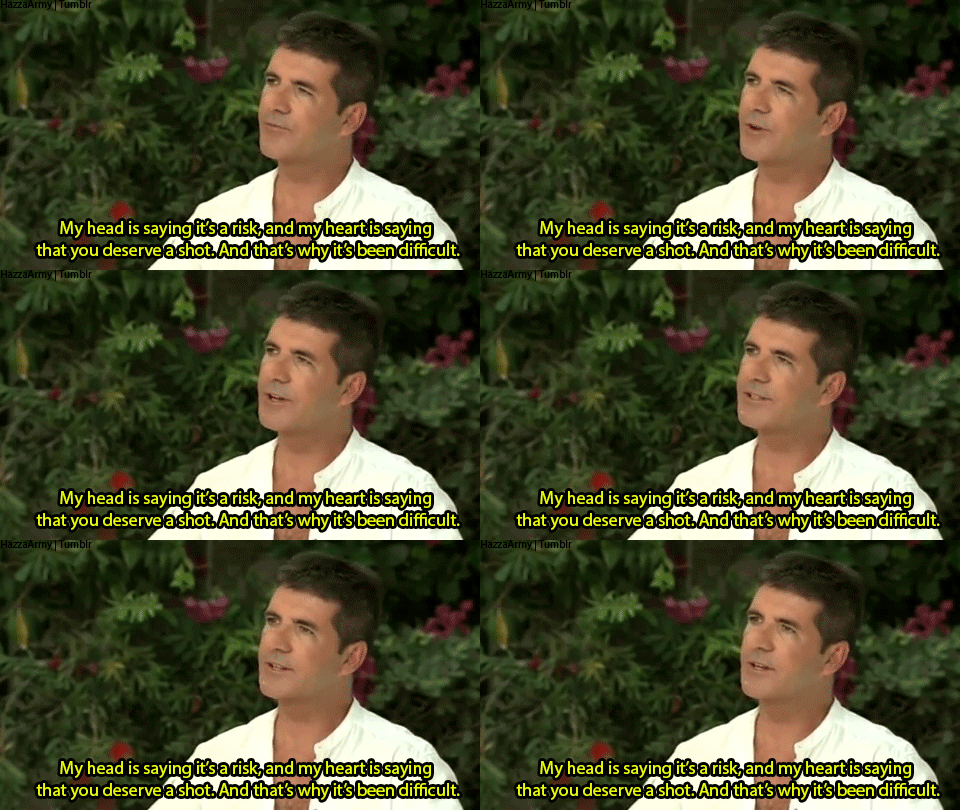
Simon Cowell probably can't define what it is that gives some singers the X-Factor--that special spark that takes them from being another member of a church choir, to overnight superstar. He simply knows it when he sees it, and even HE doesn't nail it every single time.


Agents and editors know how to spot that X-Factor in the slush pile. Simon Cowell is just one person. The best part about the literary world is that there are TONS of agents, LOADS of editors, and ALL the readers. 

So, yeah, subjectivity may be fickle, but the pool of potential readership is deep and wide. As long as you write a book YOU want to read, and more importantly, DON'T GIVE UP, you can find someone else out there who loves what you've created as much as you do.


*I read this five times before I caught my own pun. I is clearly kan write good. #TWSS


Want more from Sarah Blair? (I don't blame you) You can find her here!
Twitter: @SarahLBlair 

Saturday, December 14, 2013

The Learning Curve: A Guest Post by Kristen Strassel

I just reached THE END of my fourth book. It’s mind-boggling to think about.  Finishing this particular manuscript also closed the door on this series.  I’m actually mourning not being able to work with these characters anymore. They became such a huge part of my writing identity, as well as who I am, to not be able to live my writing life through their story is going to be just plain strange for a while. 

A writer friend of mine just nabbed an agent. While this isn’t his first book, this is the first one that just might get published.  Now he’s waiting anxiously for revisions. We chatted a bit about it last night, and I realized that the decision to publish really changed the way I wrote.

Once you want to make your book available for the world to love as much as you do, you really do have to let go. For many of us, representation means the first set of industry eyes that will look at our manuscript. I thought my first book, the one that I was offered representation on, was perfect when I got The Call. You can laugh, I’ll wait. Several rounds of revisions later, I learned how to write subsequent manuscripts tighter and more effectively. My later books haven’t needed as many revisions because of it. 

The book I just finished was the first one I started writing with the knowledge that it would be published. It intimidated the hell out of me. As I finished it, feedback started coming in on the first two books in the series. To hear how these characters effected people, and to know what they thought of the story, was extremely humbling even with good reviews. As much as we all say we write fiction, it’s hard to keep some autobiographical elements from sneaking in. I was much more aware of the rules I broke, and the how people might react to this new chapter of the story.  My main character had a major decision to make to close out the book. Would she do the right thing, the thing many readers might hate, or would she screw it all up? Were those all the same thing? I had to let my main character do what was best for her. 


In this series, many of my parameters were set by the first book. I already started working on a new book, and it’s exciting.  This new project already has all the benefits of the things I learned while writing this last series. No book is ever perfect, but thanks to books one through four, book five starts light years ahead of where I used to be. 

Want more of Kristen? You can check out her book, BECAUSE THE NIGHT, right over here and follow her on Twitter for extra awesome! 


**HAPPY HOLIDAYS, SECRET LIFERS!**
We're going on our annual holiday break, but no worries, we'll be back with more awesome than ever on January 6th. Have a great holiday, everyone!

Friday, November 15, 2013

How to Write When You Feel Like Death

Hey all,

If you've been hanging out on Twitter recently, you may have noticed that I am not there. This is a bit of a travesty, guys, because I love it there and I miss you all. But see, I'm two weeks max away from delivering my second baby, and I basically feel like death warmed over. All day. Everyday.

I'm also doing NaNoWriMo.

So there really is only so much energy allowance I have per day, and I know that I burn most of it up by 6pm. Therefore, between the hours of 6am and 6pm, I know I have to work, take care of my other slightly needy kid, and write for NaNo. Twitter is on the back-burner for now.

Which brings me to this list here that I compiled. Even though I haven't been actively tweeting, I have been stalking all of your feeds and watching you ratchet up your word counts through the insanity that is NaNo. I've also seen a few of you get the flu, start feeling run down, and just downright burnt out. That is so sad, and I feel you. My word count is abysmal at this moment. But if you're struggling with feeling awful and still have the drive to finish, I have a few tips I've picked up from my author friends and from my own experience (I was in a similar situation last year and still managed to finish!).

Let Go of Your Story: I know the point of NaNo is to complete a draft of something or other in 30 days. But I find that if I tell myself it has to be this draft, in this way, I close off all the creative floodgates when I need them most. And let's be honest, you need as much excitement and creative power as possible right now to carry you through the next fifteen days of this marathon. So feel free to give yourself some space. That plot bunny that's come up during the first half of this? Follow it down the hole. That short story you've been wanting to finish? Do it. Writing is writing, and writing is more fun when you're doing it passionately. So bring some life back into this race when you're not feeling at your best but you still want to reach the finish line.

Write or Die. Sometimes It Feels Like They Take That Literally: I love Write or Die for certain situations, like when I've planned out the next scene pretty meticulously and I know I can whip through it with a little help from Write or Die, and I feel like the words will still be decent ones. However, this is a code red situation, and you may not feel up to putting in anymore effort into planning for this story on top of actually writing it. So just turn that sucker on in kamikaze mode, and write. And don't care if they're shitty. I swear, don't. It's about survival right now, remember?

Small Chunks Are Key: Part of the reason my word count is awful is because I haven't tallied up all of my words scattered over my iPad, phone, and various notebooks yet. I write whenever I feel a tiny bout of energy bubbling up, and I write for literally five minutes (or until that energy evaporates. Sometimes it's three minutes). I don't usually operate like this, and it's kind of tough for me. I like to write in looooong stretches, because I can feel myself getting better as the time goes on. I run the same way. But when you're not feeling like your most awesome self, feel free to write for five minutes here, ten minutes there. It makes the task less daunting, plus you'll be surprised how much you actually get done throughout the day.

Rewards and Rest: I've written about rewards are rest on my personal blog before, but I'm just going to reiterate it here: you're not going to want to do this when you feel like crap if there isn't some kind of reward in it for you. I'm not talking about intrinsic rewards, the "Oh, but I feel so accomplished ones!" No. That may work when you're not stressed and sick, but that is not going to fly right now. I reward myself with Tums. How pathetic is that? But it works. My conversation with myself goes something like this: "I know you have terrible heartburn right now, but I need you to write in this notebook for five more minutes. I'll set a timer. When you're finished, you get some sweet, sweet relief in the form of Berry Smoothie Tums, mmk?" If you're not into the whole depriving your body of medicine and pee breaks tactic, try something else you want just as badly: a twenty minute nap, a fifteen minute browse on Pinterest, a latte, a cookie, whatever. I'm serious. Whatever works.

So there you have it! By the way, these tips don't just apply to NaNo. I also use these when I'm feeling under the weather or stressed any time of the year and there's a deadline I'm trying to meet. Anyway, I know you guys can do this! See you at the finish line!


Andrea Hannah is a YA writer represented by Victoria Marini of Gelfman Schneider. Her debut novel, OF SCARS AND STARDUST, is coming from Flux in Fall 2014. She writes stories about criminals, crazy people, and creatures that may or may not exist. When she's not writing, Andrea teaches special education, runs, spends time with her family, and tries to figure out a way to prevent her pug from opening the refrigerator (still unsuccessful). Oh, and she tweets a bajillion times a day, mostly about inappropriate things.

You can find her on Twitter @: http://twitter.com/andeehannah
Drop her an email @: andreahannahbooks@gmail.com
And visit her website @: http://www.andreahannah.com/